Thursday, July 20, 2006

The Conversion of Howell Harris 5: Assurance of Divine Love

On 18 June, at his home, Trefecca (pictured), Harris was granted a deeper glimpse of the love of Jesus. He recorded this in his diary:

"Being in secret prayerI suddenly felt my heart melting within me, like wax before the fire, with love to God my Saviour; and also felt, not only live and peace, but a longing to be dissolved and be with Christ, and there was a cry in my inmost soul which I was totally unacquainted with before, ‘Abba, Father, Abba, Father!’ I could not help calling God my Father; I knew that I was His child, and that He loved me and heard me. My soul being filled and satiated cried, ‘it is enough; I am satisfied. Give me strength and I will follow thee through fire and water!’ I could say I was happy indeed! There was in me a well of water springing up to everlasting life; and the love of God was shed abroad in my heart by the Holy Ghost."

From the furnace of conviction and deep experience of the love of God, Howell Harris went out into the highways and by-ways, preaching his saviour to all, desiring that every man might know Jesus as he knew Him. Revival broke out soon after Harris’ conversion, and the man from Trefecca would be mightily used of God.

Labels:

The Conversion of Howell Harris 4: A Sight of Calvary

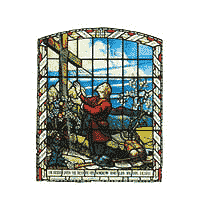
On Whit-Sunday, 1735, Howell Harris went again to Communion. He had read in a book 'that if he went to the sacrament simply believing in the Lord Jesus Christ he would receive the forgiveness of all his sins.’ Now, when he repeated the Confession, he felt every word of it in very depths of his being. As he came to Communion, Howell Harris was granted a sight of the Cross and his burden was lifted:

“I was then delivered from a grievous temptation that had followed me ever since I had first given myself to the Lord. Before that time I never knew what inward trials and spiritual conflicts were, only now and then I had some uneasiness from an awakened conscience, which was quite different from those sore trials that I bore from atheistical thoughts that made my life a burden to me; for they came with such force and power on my mind that I could not withstand them. But at the Sacrament, by viewing my God on the cross, I was delivered from these temptations; now the world, and all thought of human applause and preferment, were quite vanished from my sight; the spiritual world and eternity began, though as yet faintly, to appear; now I began to have other views and motives different from what I had; I felt some insatiable desires after the salvation of poor sinners; my heart longed for their being convinced of their sin and misery. […] I went home jumping with joy … I knew my sins were forgiven me.”

Labels:

The Conversion of Howell Harris 3: The Slough of Despond

His failure to feel the seriousness of his sins in publicconfession shook Harris. In his diary, Harris recorded:

“I was convinced that it ought to be so; and finding it was not so, I perceived I was going to the Lord’s Table with a lie in my mouth, and was much inclined to withdraw, but quieted my mind with having determined to lead a new life; and in that resolution I received the pledges of God’s dying love. I then began to be more thoughtful and serious – I was given to prayer, and strove to keep my heart and thoughts fixed on the Lord, but all in vain. Thus I went on for about a fortnight, until I almost lost my conviction. Providence, on the 20th of April, put a book in my hands, and I looked into the latter part of it as a help to self-examination; as soon as I began to read I was convinced that in every branch of my duty to my God, to myself and to my neighbour, I had fallen short, and was guilty. […] The more I read, the greater did the spiritual light shine into my mind; discovering the extent of the law of God, calling me to account not only for outward gross sins, but for my looks, aims, and deeds – in all I had thought, said, or done. Then I saw clearly that if I was to be judged by that law, I was undone for ever.”

After wrestling in prayer, Howell Harris was granted some relief. However, he still felt himself to be quite lost and without Christ.

Labels:

The Conversion of Howell Harris 2: Deeper Conviction

On Easter Day, Howell Harris returned to Talgarth Church (pictured). With the rest of the congregation, he repeated the general confession from the Book of Common Prayer:

Almighty God, Father of our Lord Jesus Christ, Maker of all things, judge of all men; We acknowledge and bewail our manifold sins and wickedness, Which we, from time to time, most grievously have committed, By thought, word, and deed, Against thy Divine Majesty, Provoking most justly thy wrath and indignation against us. We do earnestly repent, And are heartily sorry for these our misdoings; The remembrance of them is grievous unto us; The burden of them is intolerable. Have mercy upon us, Have mercy upon us, most merciful Father; For thy Son our Lord Jesus Christ's sake, Forgive us all that is past; And grant that we may ever hereafter Serve and please thee In newness of life, To the honour and glory of thy Name; Through Jesus Christ our Lord. Amen.”

But Harris felt nothing like the feeling of wretchedness which the Confession spoke of. ‘He found no inward grief at the remembrance of his sins, nor was their burden a heavy weight to his soul.’

Labels:

The Conversion of Howell Harris 1: Conviction

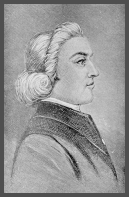
Howell Harris was the son of a carpenter from Llangadog, which, one might observe, was no bad lineage. He was educated in the Dissenting Academy of Llywnllwyd, despite being a churchman. This, according to Gwynfor Evans, ‘gave a better education at that time than the old universities of England.’ Be that as it may, Harris was admitted to Oxford. He only lasted a week, although to the end of his days Harris would proudly declare that he was an Oxford Scholar.

With his education, Harris was able to set himself up as a schoolmaster at Trefecca (there are at least three correct spellings), in the parish of Talgarth, Breconshire. It was in the Church there, on Palm Sunday (30 March), 1735, that Howel Harris was convicted of sin. The Vicar, the Rev. Pryce Davies, was warning his congregation about the dangers of not receiving Holy Communion. In the course of his sermon, the Vicar exclaimed: ‘If you are not fit to come to the Lord’s Table, you are not fit to come to Church, you are not fit to live, nor fit to die.’

These words struck Howell Harris like a sledge-hammer. He decided there and then to leave all habits that he could not reconcile with the Word of God. On the way home from Church, he hurried to the house of a neighbour with whom he had a quarrel and would not leave until the issue was settled. He devoured devotional books and prayed fifteen times a day. It was not enough, however. Harris still felt the corruption in his own heart and did not know how to lose this burden.

Labels: