Wednesday, August 23, 2006

Glasgow's School of the Prophets: Trinity College

In 1929 the majority of the United Free Church of Scotland united with the Church of Scotland (thus forming the present Church of Scotland body). Although James Denney had argued in the 1910s that the United Free Church Colleges should not be united with the university Divinity faculties the architects of the union of 1929 thought otherwise. Thus all three colleges were united to the universities in the cities in which they were located.
At Edinburgh the Divinity faculty found itself in possession of a splendid building and eventually relocated there, lock, stock and barrel. Not so at Glasgow.
The Glasgow College was renamed Trinity College and thus began the most far-reaching changes in the history of the College. It was finally decided to combine the College and University faculties by taking most of the College chairs into the university. The first change was seen in 1934, when the Chair of Natural Science endowed for Henry Drummond was suppressed - the University, after all, had a perfectly good science faculty. But things did not stop there. The following year the Chair of Church History, first occupied by James Gibson and most illustriously occupied by Thomas M. Lindsay was suppressed. Then, in 1946 the Chair of New Testament Language and Literature, occupied by Patrick Fairbairn, A.B. Bruce and James Denney in the past, was suppressed and replaced by a lectureship. The following year a lectureship in Church History was also instituted in Trinity College. Trinity College was a shadow of its former self.
But worse was to come. As numbers of students dropped in the 1960s and ‘70s it was felt increasingly difficult to justify the division of the Divinity faculty between two sites. It was decided to sell the Trinity College buildings, and they were finally vacated in 1976. Since then Trinity College has been a building without walls. It remains the part of the University of Glasgow responsible for the training of candidates for the ministry.
Note on sources:
The website of Trinity College (in case the link doesn't work)http://www.religions.divinity.gla.ac.uk/School/trinitycollege.htm

The official centenary history of Trinity College: Stuart Mechie, Trinity College, Glasgow (Glasgow, Trinity College, 1956) Hardcover. This is a very helpful outline history.

Labels:

Saturday, August 12, 2006

Glasgow's School of the Prophets: The United Free Church College III

The dream of the founders of the United Free Church had been of a church 'united, national and free'. In the late 19th century it had seemed that the only way this could be achieved was by disestablishing the Church of Scotland. The 20th century saw a change in this thinking. Disestablishment became an embarassment, and the Church of Scotland and the United Free Church entered into conference, seeking a compromise solution. The Great War contributed to this since, with a student body depleted by the war and a staff depleted by death, the United Free Church College, Glasgow, had to carry out joint classes with the Divinity Faculty of the University in the sessions 1917-18 and 1918-19.
Once the war was over new faculty could be appointed and student intake increased into the 1920s.
In 1929 the greatest change that had ever occurred in the college took place - the Church of Scotland and the vast majority of the United Free Church united. The old sign-boards were taken down and new ones painted up. For the second time in its history the name of the college changed. Now it was to be known as Trinity College, Glasgow.

What this meant for the institution we shall see, God willing, next time.

Labels:

Friday, August 11, 2006

Glasgow's School of the Prophets: The United Free Church College II

The United Free Church College, Glasgow, had come safe though the crisis of 1904, and in 1911 the extension within the gutted shell of the old College Church had been opened free of debt. Though James Orr died in 1913 he was swiftly replaced by another old United Presbyterian Professor, David W. Forrest. While Orr had been very conservative, Forrest was a Kenoticist, albeit of a very mild type (in other words, he held that Jesus had actually denuded himself of some of His divine attributes during the incarnation). All seemed to be going well. We know what happened next, of course - it was the First World War.
Student numbers plumetted, and in 1914 Principal Lindsay died. In his place was appointed the first of the college's own graduates to hold the post of principal - James Denney. The arch-liberal James Moffat was appointed to the chair of Church History.
Denney laboured hard to keep the College going, but his health gave out and he died in 1917. His successorArchibald Henderson, was an indicator of how far the College had moved since the early years - he had been one of the students accused of heresy by Professor Gibson.
Henderson was really a stopgap principal. He resigned in 1921. His successor, W. M. Clow, would see the United Free Church change radically and set her face towards a new future.
Of which more next time.

Labels:

Thursday, August 10, 2006

Glasgow's School of the Prophets: The United Free Church College I

The union of 1900 constituted the United Free Church, the second largest Presbyterian denomination in Scotland, almost as large as the Church of Scotland (though the relative sizes of the two denominations were contested). The three Free Church Colleges were taken into the new denomination and the United Presbyterian College in Edinburgh was closed. The United Presbyterian professors were dispersed around the Free Church Colleges. In some cases new chairs were instituted for them, but at Glasgow there was already a vacancy, created by the death of Professor Bruce in 1899. Denney was transferred to Bruce's New Testament chair and the redoutable United Presbyterian Professor of Church History, James Orr, was appointed to the Systematic Theology chair. Another United Presbyterian Professor, Alexander Hislop, was appointed to the new chair of Practical Theology. The United Presbyterian principal, George C. Hutton was appointed joint-principal with Dr. Douglas. Other welcome changes came with the union; the Eadie Library and the United Free Church's Kerr Lectures came to Glasgow, along with part of the United Presbyterian College Library.
Thus began the 20th century at the United Presbyterian College, Glasgow. In 1902 the joint principals retired together and Professor Lindsay was appointed Principal in their place. The crisis of 1904, when the House of Lords awarded all the Free Church property to the minority, caused some panic at Glasgow, but the minority were too sensible even to contemplate taking the Glasgow College, a college they knew they could not use. In the final settlement the Glagow College lost £20,000 of the College endowmwnts and some 900 duplicate volumes from the library.
Earlier, in May 1903, a catastrophe had taken place. The College Free Church had been gutted by fire. For five years the future of the church was uncertain, but in 1908 the congregation united with Kelvingrove United Free Church. Principal Lindsay saw the opportunity to extend the College, and so building work began to turn the shell of the church into further college accomodation; two new class-rooms, a new library, a gymnasium and a large Assembly Hall.
All seemed rosy, but no-one could see what was to come.
Of that, God willing, we shall write next time.

Labels:

Wednesday, August 09, 2006

Glasgow's School of the Prophets: The Free Church College X

In the 1870s the Free Church College, Glasgow, moved inexorably to the theological left. In the place of the dogmatic Westminster Calvinism of the original faculty there came an apologetic influence, a school that conceded much to the German theology. With the addition of George Adam Smith and James Denney in the 1890s the transition was all but complete. While George C.M. Douglas remained as principal until 1902, his conservative influence was minimal after the close of his teaching career in 1892. George Adam Smith, his replacement in the Old Testament chair was an advanced liberal, notorious for (in the words of a Free Presbyterian writer) 'Sawing Isaiah in sunder' - he believed and taught that Isaiah was written by two persons. George Adam Smith's views on the nature of prophecy were appallingly low - he taught that the prophet's message came, not from God, but from his own spirit.
Denney was the most conservative of this faculty; since he did not believe in the inerrancy of Scripture and accepted certain liberal positions on the dating of Scripture, this was NOT a good thing.
Denney was sent to Glasgow in 1897 to succeed James Candlish. Three years later a word would be added to the College name - 'United'. With the merger of the majority Free Church and the United Presbyterians a new era was to begin at the College.

Next time, God willing, we shall see what that entailed.

Labels:

Tuesday, August 08, 2006

Welsh Nonconformity and Popular Culture 7: The Stage (Part One)

In the third area of ‘literary’ entertainment, the theatre, the reaction of Nonconformity was more mixed. Efforts to capture the playhouse for Christ being viewed with suspicion and downright disapproval in many quarters. Unlike poetry, which has been used in Christian contexts for a very long time and novels, the first of which in the English language was Bunyan’s Pilgrim’s Progress, theatre has long been viewed with disapproval by Christians. In the early church, actors and actresses were barred from Church membership until they left the stage, while the Puritans closed the theatres. Theatres were seen by many Nonconformists as dens of iniquity, actresses as little better than prostitutes, and actors as mountebank seducers. As previously noted, the Methodists of the Eighteenth Century Evangelical Revival were implacably opposed to the theatrical performances known as ‘Interludes’ that often took place in churchyards after the service.

Independent minister John Roberts (better known as J.R, but no Dallas references, please), challenged this aversion to theatrical performances. Starting in 1834, he published a series of ‘dialogues,’ designed to be performed. The first of these, ‘Minister and Enquirer,’ was designed to illustrate the way of Salvation to an audience. Later dialogues included dramatizations of scenes from the Bible, such as Hanes Joseph (The History of Joseph). Coming as they did from the pen of a minister, these dialogues began to be performed in chapels (although not in the main meetings). While some believed theatrical performances could be utilized to spread the Gospel, others voiced deep disquiet, Edward Williams of Dinas Maddwy declaring that the influence of the playhouse ‘is bad even when it is carried on in the most appropriate manner.’[1]

William Williams, Hirwaun, highlighted the dangers that a performance, even when based on Biblical history, could carry, drawing attention to a performance of Hanes Joseph he had seen, in which the attempted seduction of Joseph by his master’s wife was performed, a young girl playing the part of the Egyptian temptress. This, he declared, was pure voyeurism. ‘In using sacred history in this way, we are guilty of turning God’s grace unto wantonness.’[2]

[1] Quoted in Jones, Congregationalism, p.182.
[2] Quoted in Jones, Congregationalism, p.182.

Labels: ,

Glasgow's School of the Prophets: The Free Church College IX

With the departure of most of the original faculty in the years 1872-1879 the message taught at the Free Church College, Glasgow, changed. In the place of the Westminster Confession Calvinism taught by men like Patrick Fairbairn and Dr. Gibson there came a message that was crafted in response to the spirit ofd the age. The change began in 1872 with the appointment of two professors. To replace Islay Burns, Hetherington's successor, James S. Candlish was appointed.
I first came across the name of James S. Candlish in looking for books on the Holy Spirit in the LTS library. I found a little book (always a good thing in reading for essays) entitled The Holy Spirit by J.S. Candlish. Knowing the name of R.S. Candlish, I read the book. Generally it is a good book, but some things are said about the Bible that worried me.
James Candlish illustrates one of the great problems with the early 'liberals' in the Free Church. Candlish was a Calvinist, like his father. In fact he used the Medulla Theologiae by the Puritan William Ames as his textbook. Yet he was also a supporter of Robertson Smith's advanced critical views on the Bible! It is probably due to this disconnection between his theology and his views on the Bible that J.S. Candlish is widely forgotten today.
The other professor was far more influential, and remains in print today. His name was Thomas M. Lindsay, and regulars at Free St. George's will know the name. His Magnum Opus was a two-volume history of the Reformation. Of course he was appointed to the Church History chair. Lindsay was a zealous supporter of Robertson Smith, and his influence would be great. In 1902 he would be appointed principal of the college.
The next, and perhaps the second most influential of these appointments was in 1875, when Alexander Balmain Bruce (of whom we have written before) was appointed professor of New Testament. Bruce emphasised a reductionist apologetic that made serious concessions to unbelief.
And finally, in 1879, Henry Drummond was appointed lecturer in Natural Science.

Next time, God willing, we shall see what that meant.

Labels:

Monday, August 07, 2006

Glasgow's School of the Prophets: The Free Church College VIII

In our last few posts on this topic we looked at the 'Glasgow Heresy Case'. We hope that we have made it quite clear that our sympathies are with Gibson. But Gibson was standing against the flow of the Free Church of Scotland; in a church where Robertson Smith was removed from his post not for his views on the Old Testament but because he was impolitic in stating them, it was certain that Gibson would not win the case. Indeed, soon after a great change was to pass over the Glasgow College.
When the Free Church Colleges were first founded there was a serious possibility that the Church of Scotland would use laws that were all but obsolete to exclude Free Church men not only from the professorships of the Scottish universities but also from taking courses. It was therefore felt necessary to provide not only for a theological course but also for arts and science subjects. While Edinburgh was equipped with various arts lecturers, Glasgow only had a Science lecturer. The threatened exclusion from the universities was abortive, but the science lecturer at Glasgow was kept on as part of the theological course. The lecturer appointed was Mr. William Keddie F.R.S.E. His course covered, he said, "the main topics included under the heads of zoology, geology and botany, with a special view to their bearings on the great truths of Natural and Revealed Religion." After Darwin's Origin of Species was published Keddie advertised as a portion of his course "Darwin's theory of the origin of species by natural selection shown to be untenable on scientific grounds." This was not the statement of a Bible-pounding fundamentalist, but of a knowledgeable scientist.
But in 1879 Keddie was succeeded by Henry Drummond - a well-known popularizer of Darwinism and a man whose preaching, according to Robertson Nicoll, did without any of the usual doctrines of Christianity - most worryingly the Cross.

But this was part of a larger trend - of which more, God willing, next time.

Labels:

Wednesday, August 02, 2006


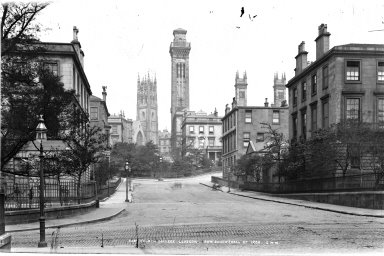
Free Church College, Glasgow, during its heyday. The campanille and twin towers dominate the streetscape.

Labels:

Sunday, July 23, 2006

Glasgow's School of the Prophets: The Free Church College VII

Following the decision of the College Committee that the four students were not in error it might have been thought that the row was over. This would have been to reckon without Professor Gibson’s fighting spirit. Gibson flatly refused to abide by their conclusions. He believed that, as a teacher appointed by the General Assembly, it was his duty to protect the doctrine of the Church. Certainly he would be remiss in his duty if he did not bring these heresies held by men who hoped to be Free Church ministers to the attention of the Church. Gibson published a pamphlet criticising the essays. In the pamphlet he also criticised the College Committee, stating that it was shielding the heretical students by raising prejudice against himself and the orthodox students. Suce a statement sounds harsh, but Gibson had good grounds for making it; the father of one of the heretical students, Mr. Archibald Henderson, was none other than Dr. James Henderson, convener of the College Committee. The personal interest was blatant.
So the College Committee passed the case to the General Assembly, the final court of appeal where there could be no such controversy over the outcome.
The Assembly took up the case on Tuesday 24th May, 18759 and spent all day and all night on the case. The final vote was not passed until half-past three in the morning on the 25th! No-one could say that the Assembly did not take the matter very seriously indeed. While the Assembly debate was firece, with James Begg as always supporting the conservative side, it was eventually decided to pass a motion that was more cautious than that of the College Committee. While the Assembly declared that it found no heresy in the essays it praised Gibson for his theological concern and his watching over the soundness of the students, while recommending that he deal more tenderly with any such cases that might arise in future. It also moved the four students in question to Edinburgh, where they would no be able to antagonise Dr, Gibson any more.
Gibson retired from the Glasgow College in 1871, and his place was taken by Professor Thomas M. Lindsay, whose biography of Luther is currently republished by Christian Focus. By this time Fairbairn had gone, to be replaced as principal by George Douglas and in his New Testament chair by Alexander Balmain Bruce. Hetherington had been replaced by Islay Burns, who himself would be replaced in 1872 by James S. Candlish, son of R.S. Candlish.
What these changes meant to the College we shall, God willing, see next time

Labels:

Glasgow's School of the Prophets: The Free Church College VI

Last time we saw how a division arose in the Free Church College, Glasgow, when some of Professor Gibson’s students disagreed with him on the matter of total depravity. It seemed that the matter had swiftly blown over, but at the end of the session 1857-8 Gibson set that class an essay entitled ‘The Scripture Doctrine of Human Depravity as affecting the Understanding, Will and Affections, with a special reference to chapter six, paragraph two of the Confession of Faith’. It was hardly a title to lull the students who disagreed with him into a sense of security. They felt that it was in fact intended simply as a test of orthodoxy for the class. In this they were not wrong.

Four essays were regarded by Gibson as objectionable. The four students in question went to the rest of the College Senate, who drew up a paper declaring that they found nothing in the men’s essays opposed to Scripture or the Confession, rightly understood. Gibson was not satisfied, but he accepted the paper as a basis for dealing with the four men.

On the last day of the session the Systematic Theology class wore a strange appearance. Gibson announced that he would read the paper prepared by the other professors in the second hour of the class, and in the first hour he would prepare the class by reading extracts from the offending essays. After the extracts from the essays Gibson read his comments on them explaining why they were unsound. No responses were allowed from the students.

The following day the Senate met and three of the four students (the other was abroad at the time) appeared before it. Gibson asked them to withdraw certain statements in the essays and the men refused. The conflict was to continue. The case was brought before the College Committee.

The doctrinal charge, while important, was not the only charge against the men. They had also been the most disruptive members of the class, making their distain for Gibson obvious.

The College Committee came to six conclusions in the case, three regarding the students and three regarding Professort Gibson. Regarding the students it was concluded first that the formation of parties among the students was to be deplored, second that the students in question did not hold erroneous doctrine, and thirdly that such disagreements between students and Professort were best dealt with by friendly conversation, not by heated controversy.

Regarding Professor Gibson it was concluded that he ought to be reminded rthat his primary duty was not to protect the doctrine of the Church but to instruct students, that it was neither necessary nor wise to engage in public criticism of individual esasays before the entire class, and that he ought to destroy the extracts he had made from the essays.

But Gibson would not let the matter rest. Next time, God willing, we shall see what Gibson did.

Labels:

Glasgow's School of the Prophets: The Free Church College V

The early professors of the Free Church College, Glasgow, were orthodox to a man, and in that they were representative of the Free Church of the Disruption. But among the younger men of the Free Church of Scotland new ideas were creeping in, mostly from Germany. These ideas caused concern among some of the professors, not least to Professor Gibson.
Due to the illness of Professor Hetherington, Gibson taught Systematic theology in addition to his Church History classes, and it was in connection with his second year Systematic Theology class that the trouble arose. It began early in the 1857-8 session with a debate in class over the nature and extent of the injury inflicted upon the intellectual powers of man by the fall. Gibson and the majority of the class agreed with the Westminster Confession but a small minority disagreed, not on Biblical grounds but upon philosophical.
The division in the class demonstrated by this became obvious when Gibson set them an essay on ‘The Unity of God’. It was Gibson’s custom to read students’ essays in class and to criticise them, individually, there. Usually the essays were given in simultaneously but in this base they were not. Gibson took the first essay and tore it apart, castigating the author for his unsound and dangerous views.
The man’s friends were stung into action and the class took sides, the minority writing against their professor and the majority writing in defence of his views.
The issue was how far the unaided reason of fallen men could comprehend the nature of God. While both sides admitted that creation and providence revealed the existence, power and goodness of God, Gibson and his supporters contended that the natural man could not recieve this truth due to the depravity of his heart, while his opponents contended that he was capable of recieving it. Gibson told them in no uncertain terms that this was to, in effect at least, deny the doctrine of human depravity.
The division grew as Gibson made very clear that he regarded the minority as being in dangerous error, preferring human philosophy to the Bible. The students appealed to Fairbairn, who brought the matter to be investigated by the Senate. It seemed the matter was at an end.
However it was not. What happened next deserves to be told and will, God willing, be told next time.

Labels:

Friday, July 14, 2006

Glasgow's School of the Prophets: The Free Church College. IV

The Free Church College, Glasgow, officially began on Tuesday, 4th November 1856. That day the Free Presbytery of Glasgow met in Free St. Matthew's Church to induct Professors Fairbairn and Gibson into their chairs. Fairbairn gave his inaugural address, and it was intimated that Professor Gibson would give his inaugural lecture in a building in Thistle Street formerly occupied by a training school. The following week regular lectures would begin in the same building. Five second-year students from Glasgow who had been at New College elected to complete the remaining two years of their course at the new Glasgow college, while either twenty or twenty-three students (we do not know why there should be confusion, but there is) entered the College. Rev. George C.M. Douglas of Bridge of Weir was engaged to conduct the Hebrew classes, beginning an association with the college that was to continue until 1902.
In 1857 the Assembly appointed two more professors. Mr. Douglas was appointed to the Chair of Old Testament Language and Literature, and Dr. William M. Hetherington, the historian of the Westminster Assembly, was appointed Professor of Apologetics, indicating a focus that was to distinguish the College for many decades. Dr. Hetherington also taught Systematic Theology, but sadly ill health would severely curtail his usefulness in his post.
Meanwhile building work was progressing rapidly. The Assembly on 1857 was informed that the building was externally complete apart from to soaring Campanile and the two smaller towers on the College Church. Internally work was progressing rapidly, and the building would be ready for the next session. While the Campanile proved more expensive than had been anticipated, its cost was paid by extra funds provided by the Memorialists.
The two new professors were inducted by a Presbytery meeting in Glasgow's Free St. George's (no relation) on 29th October 1857, and the opening ceremony of the College buildings was held on Wednesday, 4th November. The Moderator spoke, and Principal Fairbairn delivered an address outlining his ideas of a sound theological education. The building was complete apart from the belvedere atop the campanile, from which students and professors would be able to survey Glasgow. While the campanile undoubtedly adds presence and completeness to the College buildings, we are not entirely sure what it was for. Did Principal Fairbairn have an office in it? We would like to think so!
Next time, God willing, we shall see how students and professors fared when allegations of heresy were in the air!

Labels:

Glasgow's School of the Prophets: The Free Church College. III

The Assembly of 1856 had decided that the Free Church College, Glasgow, should open for students in November of that year. For that to be possible, however, it was necessary for them to appoint professors. The principal's office ame first, and it was decided that the best man for the job was Dr. Patrick Fairbairn. Dr. Fairbairn is not unknown to those who study the Reformed theology (which we are persuaded is also the Biblical). His The Interpretation of Prophecy in the handsome hardcover edition published by the Banner of Truth graces the shelves of many a Reformed man, Dr. Peter Masters republishes Fairbairn's Ezekiel, and his Typology is to be seen on the shelves of the Tabernacle Bookshop. No less a man than Dr. James White has greeted with joy the republication of Fairbairn's Hermeneutical Manual (under the title Opening Scripture). In short, Fairbairn is Sound. A brilliant man, he ministered for a long time in Orkney, teaching himself Hebrew in the long winter nights.
Fairbairn's Chair in the College was New Testament Language and Literature. His Hermeneutical Manual gives an insight as to his teaching methods.
For the Chair of Church History the Assembly chose James Gibson, then a minister in Glasgow, and for the Chair of Old Testament James M'Cosh, then of Belfast. While Fairbairn and Gibson accepted the appointments, McCosh declined. Later he was to become President of Princeton University. This meant that the college, intended to be second after New College, Edinburgh, would have to start with only two professors and interim provision for the teaching of Hebrew.
Meanwhile, on 18th August 1856, the foundation stone of the Free Church College, Glasgow, was laid by Rev. Thomas M'Crie the Younger, son of the biographer of John Knox and author of the Sketches of Scottish Church History (Republished by Free Presbyterian Publications as The Story of the Scottish Church), who was Moderator of the Assembly that year. In his address he spoke of the College as "an institution which promises to be a centre of illumination to the country at large."

God willing, next time we shall look at the Commencement of the College

Labels:

Glasgow's School of the Prophets: The Free Church College. II

In 1856 Glasgow was a large and growing city. It held its place as Scotland's second city and rejoiced in its motto of 'Let Glasgow flourish by the preaching of the Word'. It was the year in which Glasgow's art collection was begun. Glasgow was flourishing, and the leading Free Churchmen of the city looked in dismay at their own lack of a College. Something had to be done.
It was done, in 1855, but not by the Free Church. A group of Glasgow businessmen and professional men presented a Memorial to the 1855 Free Church General Assembly offering to build and endow, entirely at their own expense, a college for the training of Free Church ministers in Glasgow. The Assembly were no longer able to drag their feet, and they accepted the offer.
Unfettered by committees the Glasgow Memorialists went to work quickly. Before the next General Assembly they had acquired a site for the College and plans had been drawn up by the architect selected, a Glasgow Architect called Charles Wilson. Wilson's design was in the Italianate style, dominated by a soaring Campanile or tower. The building was to provide four class-rooms with private rooms for the professors, a public hall and a library. Dr. William Clark, leader of the Memorialists, also gave a church, adjoining the college and designed by the same architect, on condition that fifty seats be reserved for the use of students.
The buildings would not be ready until late in 1857, but the Memorialists petitioned the Assembly with the suggestion that Professors should be appointed and classes begin, in rented accomodation, in 1856. The Assembly agreed, and so 1856, 150 years ago, is the official date of the founding of Free Church College, Glasgow.
Next time, God willing, we shall take a look at the early faculty, and at the progress of the College.

Labels: