Friday, November 17, 2006

A. B. Taylor. XI


After thirty-eight years at Rochdale Road, Taylor came to die. He was taken back to his comfortable cottage near Manchester, and there he was confined to bed on July 1st 1887. He was weakening, and on July 5th, in the morning, he repeated the verse:

Let me not murmur or repine
Under this trying stroke of Thine,
But bow beneath affliction's rod,
Be still, and know that Thou art God.

As he lay dying Taylor's mind often went to the great hymns of the faith. He had been a good singer, and taken great care in the singing of the congregation. No wonder that part of his life should comfort him on his death bed. Tellingly one of those was the Scottish metrical version of the 23rd Psalm, taught to him by his mother when he was still a small child.

Goodness and mercy all my life
Shall surely follow me,
And in God's house for evermore,
My dwelling-place shall be.

In the hot summer he suffered terribly, quoting once those lines,

Though painful at present, 'twill cease before long,
And then, O how pleasant, the conqueror's song!

"Patient in tribulation, continuing instant in prayer," he quoted.
"How a tempting devil hunts about for the precious life," he reflected on another occasion, "but he can't find it! It is hid with Christ in God."

Thy mercy, my God, is the theme of my song,
The joy of my heart and the boast of my tongue;
Thy free grace alone, from the first to the last,
Has won my affections and bound my soul fast.

Thy mercy in Jesus exempts me from hell,
Its glories I'll sing and its wonders I'll tell."
And he kept on doing so, even in the pain, until he could speak no more. His last words were "It is well, it is well." Then he lifted his left arm and pointed upwards whispering, "I am going."
That was on Saturday 6th August, the end of his struggles, during which he was supported by the grace of God, came in the early hours of the following morning. He passed away peacefully at a quarter to four in the morning of Lord's Day 7th August, 1887. One of the hymns he quoted in his last illness sums up his hope:

And when this heart and flesh shall fail,
And mortal vigour cease,
I shall possess within the veil
A life of joy and peace.

A. B. Taylor's funeral service was held in Rochdale Road chapel, Manchester. Over 800 people were present in the chapel for the service. George Chandler of Accrington, speaking at the committal, said, "Perhaps the leading feature in our friend's ministry was the person, work, sufferings, blood, righteousness and offices of the Lord Jesus Christ."

And so ought to be the leading feature of every Christian ministry.

[The main sources of this essay are S. F. Paul, 'Further History of the Gospel Stand Baptists' Vol. 4 (Brighton, 1961). Contains accounts of Manchester and Accrington Churches; B. A. Ramsbottom (ed.) 'Six Remarkable Ministers' (Harpenden, Gospel Standard Trust, 1994). A. B. Taylor's life, mostly by himself, is to be found on pages 85-137; and B. A. Ramsbottom, 'William Gadsby' (Harpenden, Gospel Standard Trust, 2003)]

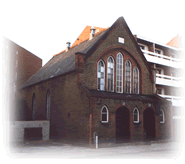
Illustration: Rochdale Road chapel in about 1960. This chapel is obviously not the original. Built in 1907 on the old site, it retains the pulpit from which William Gadsby and A. B. Taylor preached.

Labels:

Tuesday, November 14, 2006

A. B. Taylor. X


A. B. Taylor remained the pastor of Rochdale Road chapel, Manchester, for the rest of his life. As 'Gadsby of Manchester' had been a household name among Strict Baptists, so now 'Taylor of Manchester' was. Under his ministry the attendence increased, and in 1871 when the religious census was taken there were 950 present at the service. A large, impressive-looking man with a solemn manner and splendid voice, he became as much a part of Manchester life as Gadsby had been. Although we have no information on the subject, it is tempting to think that not a few young men preaching in the Rochdale Road pulpit felt that they had Mr. Taylor on their backs!
Unfortunately, while Taylor wrote a fairly detailed account of his life before the call to Manchester, it ends just after the beginning of his ministry, and no biography of him was written at the time of his death. At this late date it is impossible to attempt the task. Letters have been destroyed by the ravages of time, precious memories have gone to the grave, and all we have are a few fragments.
Taylor was a preacher before he was anything else. Many of his sermons were published in 'The Manchester Pulpit', volumes of which are incredibly rare. We have in the Free St. George's Library a few sermons roughly bound by the person who bought them. Taylor alo wrote poetry, and some of it was published in his lifetime. Sermons by A. B. Taylor were also published in the 'Gospel Standard' magazine.
Although he often preached away from Manchester, Taylor was without a dount the PASTOR of the church meeting at Rochdale Road chapel. He took a keen interest in the services themselves and, having been a singer in his early life, maintained a high standard of congregational singing. No organ was allowed in Rochdale Road during his pastorate, and some of the Gospel Standard churches have maintained the tradition of unaccompanied singing to this day.
Taylor's home life was in some respects idyllic. When he first came to Manchester in 1848 he took a cottage called Collyhurst Cottage where he was able to keep a cow. In 1851, however, he bought a small farmhouse called Moss Cottage in Middleton (the picture is of middleton Parish Church). There he was able to keep a little farm. Generations of Strict Baptist Sunday School chiuldren from Manchester had cause to bless God for that cottage and its farm, for every year they were carried out of Manchester and its smoky streets and busy mills to a little farm, where their pastor and his wife entertained them.
Mr. and Mrs. Taylor had twelve children, several of whom died in infancy. Two of his daughters died in adulthood, his eldest daughter died in 1864, followed by her husband. So , at the age of sixty, Taylor had his young orphaned grandchildren placed in his care. on 14th January January 1865 Mrs. Taylor died. No doubt the presence of the grandchildren cheered him in the years that followed
After thirty-eight years in the pastorate at Manchester the end of his earthly service came to Mr. A. B. Taylor in 1887. After a period of decline he preached what proved to be his last sermon on June 26th, speaking for half an hour on the text 'every plant, which My heavenly Father has not planted, shall be rooted up.' He was unable to finish the sermon. Very ill, he had to go home.

His death, God willing, shall be our subject next time.

Labels:

Thursday, November 09, 2006

A. B. Taylor. IX


In 1848 Alexander Barrie Taylor, pastor of what is now Peel Street Baptist Church, Accrington, was called to the pastorate of what was then known as St. George's Road Chapel, Manchester (Now Rochdale Road, the name of the road was changed in 1848). Although the Manchester pastorate was more prestigious, Accrington was far more inviting. The Manchester church was in a divided state and numbers had fallen off since William Gadsby's death, while the church at Accrington was united and pressing forward with a new building scheme (which produced the current Peel Street chapel). The deacons and the people pressed Taylor to remain at Accrington, but he felt the call of God to try to bind up the wounded church at Manchester. At first he felt utterly unable to do the work, but while he prayed about it the text came to his mind, 'Not by might, nor by power, but by My Spirit, saith the Lord of Hosts.' "... all was to be done by the Spirit of the Lord of Hosts. O, what I sight I had of the hosts the Lord can marshal when He gives command!" Taylor wrote. It was this realisation that all was to be done by divine power that opened up the way before him, and so Taylor accepted the call in a spirit of deep humility.

A. B. Taylor's ministry in Manchester began on the first Lord's Day of December, 1848. His first text was 1 Timothy 1.2, 'The glorious gospel of the blessed God'. It was a manifesto as well as a sermon. This was to be his theme throughout his pastorate of thirty-eight years. Yet at the beginning the faith that brought him to Manchester was mingled with unbelief. He retained his engraving tools for a year, in case he was forced to return to them.
The secession, he discovered, had taken away most of the divisive element, and now that the church had a pastor his visiting and preaching brought others round to the changed state of things.
The year he had given himself came to an end, and rather than the church flying to pieces he found that a number had been added to the church during the year. At the same time his last employer, knowing that Mr. Taylor had given up engraving, offered to buy his tools and machinery for the original cost. So he sold them and continued to give himself wholly to the preaching of the gospel and the ministry of the church at Rochdale Road.

Next time, God willing, we shall look at the Manchester pastorate.

Labels:

Wednesday, November 08, 2006

A. B. Taylor. VIII


In 1840 A.B. Taylor had been called to the pastorate at what is now Peel Street Chapel, Accrington. For personal reasons, he declined. He felt that a pastor ought to be able to give himself fully to the work, but the Accrington church was unable to support a man with a family as large as his. He did however continue preaching.
The Gospel Standard denomination, if I may call it that, did not exist formally in the 1840s in the way it came to later. The founders of that denomination, William Gadsby, John Kershaw and John Warburton, were however influential Strict and Particular (Closed-communion Calvinistic, that is practising reSTRICTed communion and teaching a PARTICULAR atonement) Baptists and a network of churches was forming around them.
Then, as now, one way a man got invitations to preach was through a more influential minister mentioning his name in other places. There were few Strict Baptists as influential as William Gadsby. He secured an invitation to Taylor to preach at Zoar Chapel, Great Alie Street, London (the present Zoar Chapel, now used by the Free Presbyterian Church of Scotland, is pictured). Taylor also had invitations to preach at the Baptist Church in Liverpool formerly pastored by Samuel Medley the hymn-writer, to Gower Street Chapel, London, and to Alfred Street Chapel, Leicester.
In 1844 William Gadsby died. The following year Accrington approached Taylor again with a call to the pastorate, and this time he accepted it. He began his ministry in July, running an engraving business as a 'tentmaker'.
But it was only a short ministry, for in 1848 William Gadsby's former Church, Rochdale Road chapel, Manchester, called Rev. Alexander Barrie Taylor to the pulpit in which he had once felt that he had Mr. Gadsby on his back! The church had suffered badly since Gadsby's death, and there had been one major split. It was not the sort of church where a young pastor would necessarily WANT to go. On the one hand Taylor had his people at Accrington and his little business, on the other a church with a large chapel, and some serious divisions.
But after much prayer A. B. Taylor felt the call of God to accept the Manchester pastorate, ad to try to stabilise a church that was on the verge of collapse.

How he went about that we shall, God willing, see next time.

Labels:

Tuesday, November 07, 2006

A. B. Taylor. VII


Different men have different reactions to being asked to preach. Of course all who are truly called to the ministry are apprehensive and diffident, but some more obviously so than others. Alexander Barrie Taylor was initially terrified (admittedly the teapot-throwing incident may have affected him). Having preached several times at his own Church, the Church recognised his gift and authorised him to preach wherever he was invited. The fact that there were people praying for him was a great comfort.
However, he was not immune to discouragement. On one occasion he was called to preach at Sabden (illustration: the old Baptist Chapel), but on the way he was overcome by an attack of uncertainty and he felt unable to preach. Feeling wretched, he lingered on the moors until all the churches in Accrington had begun their services and he wandered back.
On the way Taylor entered the old Methodist Chapel in Accrington. Behind the minister the words 'take heed how ye hear' were written on the wall. Taylor took heed and was astonished at the theology he heard. When the preacher finished by saying that Jesus was standing, holding off the stroke of God's wrath to see if men should come, Taylor, brought up a Calvinist in Scotland and trained in English Particular Baptist Churches of the Gospel Standard stamp, was horrified. Here, he thought, was man's plan of salvation, not God's.
The next Lord's Day the Church at Sabden sent a man to escort Taylor safely there, and he found the people, and their pastor, very friendly and supportive.
Taylor was soon preaching in a number of small churches, and some that were not so small, in his area. The most intimidating for him was Gadsby's Church in Manchester, for there he felt, as he put it, "that I had Mr. Gadsby on my back, and could not get him off."
He was called to the pastorate at Accrington, but since the church was unable to support his large family, he had to refuse.


Yet it was evident that he was intended for the pastorate, and in due time a call came. How it came, and by what means, will be our topic, God willing, next time.

Labels:

Friday, November 03, 2006

A. B. Taylor. VI


William Gadsby (pictured) was undoubtedly one of the great Christian leaders of the early 19th century. Originally from Attleborough near Nuneaton in Warwickshire, he had been called to the pastorate at what is now called Rochdale Road Chapel, Manchester, in 1805. By 1834, then, Gadsby was quite a fixture in Manchester. Since A. B. Taylor loved Gadsby's hymn-book, it was only natural that he should fix on Gadsby's chapel as his spiritual home in the metropolis.
Soon after the move to Manchester, Taylor's health began to suffer. Gadsby, always a concerned pastor, prayed with him. One day, in the service, Taylor was overwhelmed with a knowledge of the love of God shed abroad in his heart. The assurance he had lacked for so long came now in a wonderful golden tide, and he rejoiced 'in joy unspeakable and full of glory.'
Because of his health Taylor was forced to move out of Manchester again and back to Accrington, then a town outside Manchester. On the Lord's Day he went to the chapel in Blackburn that was connected with Mr. Gadsby. It was there that he was finally baptized into the Divine Name in obedience to a command that he had hitherto not obeyed because of his lack of assurance. For the first time since he had left Scotland, Alexander Barrie Taylor was received into the membership of a local church.
The more experienced members of the church carefully taught Taylor in the things of God, and in due time the membership felt that their brother had been gifted by God as a preacher. He was asked to preach at one of the Lord's-day meetings, but for fear did not tell his wife. She found out some other way, and her reaction was hardly positive - she threw a teapot at him!
He still preached, and his wife repented of the teapot-throwing incident.
There being quite a number of people who walked to the Blackburn chapel on Lord's Days, it was decided to plant a church at Accrington. One was finally set up in 1836, and continues to this day as Peel Street Baptist Church. A pastor was called, but Taylor was often asked to preach at the chapel. It seemed now that God was guiding him towards the ministry of the Gospel.
And that, God willing, shall be our subject next time.

Labels:

Thursday, November 02, 2006

A. B. Taylor. V


Alexander Barrie Taylor was not one of those men who can give a date for their conversion. Unlike John Wesley or C. H. Spurgeon, for example, Taylor's awakening was long and drawn out. He could not tell when it began, but he knew that he had passed from death to life.
Like many young Christians, Taylor's religion was initially shallow. Since he was intended for a great work, he was not long without trials. His favourite sport was shooting, but he found he was unable to enjoy it. It seemed to him that it had become an idol. He was thinking too much about shooting and not enough about God. At the same time he was greatly exercised with thoughts of the reality of the Second Coming, and the fact that this world would all be burned up.
Deeply unhappy, he tried to get a post in Scotland in order to get away from his worldly friends, and he succeeded. On his way to Liverpool to take passage to Greenock on the 'City of Glasgow' steamer he heard William Gadsby preach at the Tuesday evening Bible study, where Gadsby preached on the text 'Say unto the cities of Judah, Behold your God'. At Liverpool he went on board expecting a safe journey.
He was wrong. That night a terrific storm broke on the ship. Even the sailors were afraid. Taylor's mind went again and again to Gadsby's text as the waves smashed over the steamer. All night the storm raged, and when daylight came the proud steamer that had sailed from Liverpool was a sorry wreck, masts and funnels carried away by the storm, drifting helplessly, without lifeboats, since the storm had carried them away as well.
The ship drifted helplessly all day, until at evening-time two other vessels were sighted, steamers that had been sent to search for the 'City of Glasgow'. The wrecked ship was towed into port. Speaking to the Captain Taylor said, "Captain, we have had a terrible night."
"I have been at sea thirty-two years," the captain replied, "and I never saw the like before; nothing but Almighty God has preserved us." He spoke in awed tones.
In Scotland Taylor learned that it is foolish to try to run away from the world so long as we are in the world. He found new companions every bit as bad as those in Lancashire, and so he decided to go back to Lancashire again. There he began to read the Bible seriously and to attend on ministries of a more decidedly Calvinistic character. But instead of getting any better Taylor only felt he became worse. He bought a new hymn-book that had been published by the Manchester minister who had been a help to him in the wreck of the 'City of Glasgow'. At lest, in 1834, a new post took A. B. Taylor to Manchester, where he of course became a member of Gadby's congregation.

And what happened there will, God willing, be our subject next time

Labels:

Wednesday, November 01, 2006

A. B. Taylor. IV

Despite the care and the prayers of his parents and pastor, Alexander Barrie Taylor grew to manhood in Scotland as a careless, carnal sinner, a stranger to grace and to God. His chief delights in life had been shooting and fishing, not the things of God. But with the need to go to England for work he was shaken out of his carelessness.
In the 1820s the easiest way to go from Perth to Lancashire was to go by road to Glasgow, and then to take a ship from Glasgow to Liverpool. Taylor was a friendly young man, but England was another country. I dare say that a Scotsman moving from Perth to Preston today would find Preston a strange place, and in the 1820s the differences would have been even more pronounced.
Taylor stayed at the 'Legs of Man' hotel in Preston, and the landlord there proved to be another Scotsman. The landlord took great pleasure in telling the young apprentice about the more unpleasant customs of the local people, such as their drinking-bouts and their manner of fighting. Taylor was quite afraid of them and decided he had to stay away from such bad company.

It was a cruel thing to do to a young man recently arrived in a strange country, but it was used for good. Lying on his bed that night Taylor thought of home, of his parents and his pastor. His mind dwelt upon his sin. He had not lived as he ought, he had sinned against a holy God. He had a certificate of Church membership, but he realised that it meant nothing as to his soul. He needed a certificate from another, higher court for that.
And then, as he felt crushed under the Law of God, it seemed to him that a voice spoke to him in the darkness; "Commit thy way unto the Lord, trust in Him, and He shall bring it to pass."
He sat up, "What do you want with me?"
There was no audible answer, but those words echoed in his mind, "Commit thy way unto the Lord." They came with the force of a commandment, and Taylor committed his way to God. This is what he says about the experience.
"My fears were now removed, my heart was warmed, and I felt that my whole soul and body were filled with a glorious something which I cannot well describe. That was the strangest thing that has happened unto me up to this time, but that I felt all this no power can now disprove."
He woke happy and as he walked past the Old Church in Preston he sang 'The Lord's my Shepherd.' Yet he was not yet fully set at liberty. Like Bunyan and Spurgeon he still had some way to go. Yet he was being led by God in the way.
He soon had a post at Accrington, and there he met his wife. They were married in what is now Manchester Cathedral on 6th October 1828. In Accrington he went to the old Particular Baptist Chapel, pastored by Mr. Joseph Harbottle.

Yet he had deep waters ahead of him. How God brought him through them we shall see, God willing, next time.

Labels:

Thursday, October 26, 2006

A. B. Taylor. III.

Like many young men, even from Christian households, young Aleck Taylor looked forward to working away from home. The early years of idependence can be a snare to young people from Christian backgrounds, as a heart that is not stayed upon God has the opportunity to rebel. Although he went to Glasgow with a certificate of membership to enable him to attend one of the United Secession Churches in Glasgow, he left the certificate in his trunk and threw himself into all the pleasures Glasgow had to offer. Looking back, Taylor was astonished at how much he had been kept from sin by the mercy of God. "I was at this time a vain and foolish fellow, mixed up with many things, the song and the dance, made smart with curled hair and fine slippers, albeit my good minister's certificate was at that time in my trunk."
Again we say, beware if all YOUR religion is in a certificate or a church book. Both will be burned up on the Last Day.
Even an accident in which he fell through ice and nearly drowned did not give him any concern
Yet God was working in his life. At that time Dr. Thomas Chalmers was the wonder of Glasgow, the greatest orator in the city. His preaching was something everyone in Glasgow went to - and Taylor went. Yet his heart was not affected in any lasting way beyond occasional fears of death.
Then the company closed, and he had to return to Perth. That filled him with concern, for Mr. Jamieson was certain to know that the certificate he had given Aleck had never been presented. He tried to avoid him, and when he had arranged to go to England to complete his apprenticeship he thought that he had accomplished his objective.
He had not. One day Mr. Jamieson met him on the road and asked about the certificate. Stumblingly, Taylor explained that he had felt he would not be long in Glasgow, so he had hesitated before transferring his membership. Jamieson observed that he would need another certificate if he was going to Lancashire. That put Taylor in a very awkward position, for he had already asked a certificate from another church. He explained.
Then Mr. Jamieson looked at him very earnestly and said: "I have a favour to ask you before we part."
Writing later, Taylor confessed he would have said anything just to get rid of the godly minister. He said he would agree to it, whatever it was.
"The favour I ask of you is, to read your Bible; you know not what God has for you to do. You are a child of many prayers; you know not what God has for you to do. Read your Bible."
The words sank into Taylor's heart, "read your Bible." Although he tried to dismiss them, he could not.
That summer (1826) A. B. Taylor felt a strange and affecting sense of the sufferings of Christ for sin. Although he had often heart of the death of Christ, now it came home to his heart with a peculiar power. Yet he was not yet a Christian, and he was still in sin.
But now the time came for him to leave Scotland and go to England. "Surely, 'God brings the blind by a way they know not.'" Taylor observed in later years.
God willing, next time we shall consider Taylor in England, and what happened to him there.

Labels:

Thursday, October 19, 2006

A.B. Taylor. II.

Alexander Barrie Taylor was, as we have said, brought up by pious parents who were members of the Secession Church. At that time most Scots were presbyterians, either of the Church of Scotland, the Secession Church, or the Reformed Presbyterian Church. There were however a few Baptists and Independents. In God's providence some of these Baptists lived close to the Taylor family, and in his childhood Taylor had discovered that they had not Baptized their baby. Like many, young Taylor was amazed to hear that, and said he was sorry that such parents should have children. His mother told him that the child was really no worse off for not being baptized.
That puzzled young Taylor. If a child was as well unbaptized as baptized, then what really was the point of Baptism? It is the sort of thing children sometimes say, and Mrs. Taylor was not really sure how to answer. That left her son with some suspicions that maybe these Baptists were right.
As often happens in paedobaptist churches, when young Aleck (as he was called) grew older, he was proposed for full Church membership by his father, a good man, but one who was disturbed by his son's doubts concerning the Baptism of infants. Perhaps he thought that Aleck ought to be thinking more about his own relationship with God and less about questions of Church order!
A. B. Taylor consented, and he was placed in the communicants' class to prepare him. At the time he was still a worldly man, and he preferred his shooting to the classes.
He was well taught, and as far as the examinations were a test of Bible knowledge he passed them. But the minister, John Jamieson, knew that, as Hart puts it,
True religion's more than notion,
Something must be Known and Felt.
"Did you ever feel any portion of God's Word to be a comfort to your heart as touching another world?" he asked.
Taylor was taken aback. To be refused full membership would distress his parents but, as he would write later, "Such an idea had never entered my head, let alone my heart." He was caught, and he took the path of least resistance - he lied. Jamieson had recently preached a series from the text 'Him that cometh unto Me I will in no wise cast out," and so Taylor repeated that text.
On the strength of that lie he was admitted to full Church membership and given a communion token. Not that he was irreligious. He was formal, serving the Lord in a natural way and living like the world. Before we judge Mr. Jamieson for his letting such a man into church membership, how many of our Evangelical Churches today would do the same? How many men are there in our churches who profess to serve Christ, yet live just like the world?

Next time, God willing, we shall continue with Taylor's life leading up to his conversion, and we shall see how he was brought out of his carnal security.

Labels:

Wednesday, October 18, 2006

A.B. Taylor. I.


It will have been noticed by our readers (assuming the Marcus Dods series didn't get rid of all of them) that we have tended to refer particularly to Scottish Presbyterianism. Those who know the true identity of the editor know that he is no Presbyterian! But the field of Scottish Church History is dominated by Presbyterianism. However there are notable exceptions. Congregationalists and Baptists both have honourable Scottish histories. Scotland has not only had many great preachers who ministered chiefly within its borders, but also she has given great preachers to England. One of them was Alexander Barrie Taylor.
Born on October 18th, 1804 (so today is the 202nd anniversary of his birth), in the village of Craig Hall near Pittendynie, about three miles from the city of Perth, A. B. Taylor (as he is normally called) was born into a poor but pious family connected to the Secession Church. His parents taught him to repeat the 23rd Psalm and the last three verses of Matthew 11 before he could read. Born and brought up in the country, he had a fairly happy childhood. His parents tried to bring him up in the fear and admonition of the Lord.
At the age of six he was sent away to a school kept by a Mr. Dick. Mr. Dick had trained for the Secession ministry but, due to some sin on his part, he had been barred from it. Looking back on his childhood Taylor reflected, "Perhaps the Seceders of those days saw too clearly, 'Be ye clean who bear the vessels of the Lord.'"
For six years, until the age of twelve, Taylor remained with Mr. Dick. Then disaster struck the Taylor family. The Corn Laws caused an increase in the price of bread, and the sort of smallholding that the Taylors owned became uneconomical. Only tenants, the family were evicted.
Like many such familes, the Taylors went from the countryside to the city, seeking employment in factories. In the case of the Taylors they went to Perth, just a few miles from their own home, and a fairly small city. A. B. Taylor became a worker in the calico industry. By the time he was eighteen he was apprenticed as an engraver. It was a good company, and the appentices were taught free of charge on week evenings by a schoolmaster employed by the company.
But in 1824 disaster struck. The company for which he worked went out of business A. B. Taylor, like many a young man, went to the rapidly expanding industrial city of Glasgow to seek employment. As an engraver, a skilled craftsman with a skill that was much in demand, he got a situation.
The Taylors were members of the Methven United Secession Church, and their pastor was Rev. Mr. Jamieson, an honest Christian man. In the 1820s much of the true religion in Presbyterian Scotland was to be found in the United Secession Church. But Alexander Barrie Taylor had none of it. A careless, carnal sinner, he went to Glasgow accompanied by the prayers of his family and pastor.

Next time, God willing, we shall see what Taylor found in Glasgow.

Labels: