Monday, September 04, 2006

The Decline of Welsh Nonconformity 10: Conclusions
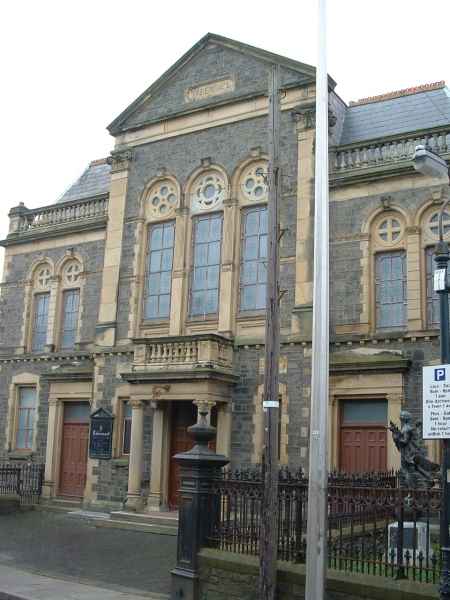
There is one clear objection to this view of nonconformity in decline: the revival of 1904. Surely, this great revival gives the lie to notions of Christianity in crisis? Yet the tides of revival ebbed with astonishing speed. The slide towards doctrinal compromise was unaffected, although the revival had touched the colleges.[1] With its emphasis on individual experience, the revival, if anything, accelerated the move towards a pietistic Christianity that had little to say to the world outside the churches.

To what extent, then, was nonconformity in decline before 1914? The decline was not fatal, was not the precipitate decline in numbers that was to take place after 1918, and especially after 1950. But, nevertheless, it was a serious decline. Welsh nonconformity, in exalting subjective experience over objective faith opened the door to doubts about the authority of the Bible. Welsh nonconformity exalted cultural and social activity over religious activity, bringing in members who valued churchgoing for its social role. The danger here was that members who came to see the church as little more than a social club would leave when better social activities became available. The church, uncertain of its own doctrines, was unable to enunciate a constructive alternative to a socialism that would eventually rob it of its place in many Welsh hearts. To put it bluntly, in the years 1890-1914, nonconformity took a decisive step towards irrelevance.

[1] Davies: Light, p.101. See also: Sheehan: ‘Decline’, pp.15-22.

Appendix: Loss of Membership in the Calvinistic Methodists (Presbyterians) and Baptists, 1897-1907:

Calvinistic Methodists:
Average number of Members lost per year between 1897 and 1900: 2,631
Members lost 1905: 5,492
Members lost 1907: 5,437

Baptists:
Average number of Members lost per year between 1897 and 1902: 2,639
Members lost 1906: 5,949
Members lost 1907: 5,489

Members excommunicated average 1890-1903: 1,243
Members excommunicated 1906: 2,417
Members excommunicated 1907: 2,457
In both denominations the greatest losses took place in Glamorgan and Monmouthshire (Source: Jones, Faith, pp.363).

Labels:

Saturday, September 02, 2006

The Decline of Welsh Nonconformity 9: Politics and 'The New Theology.'


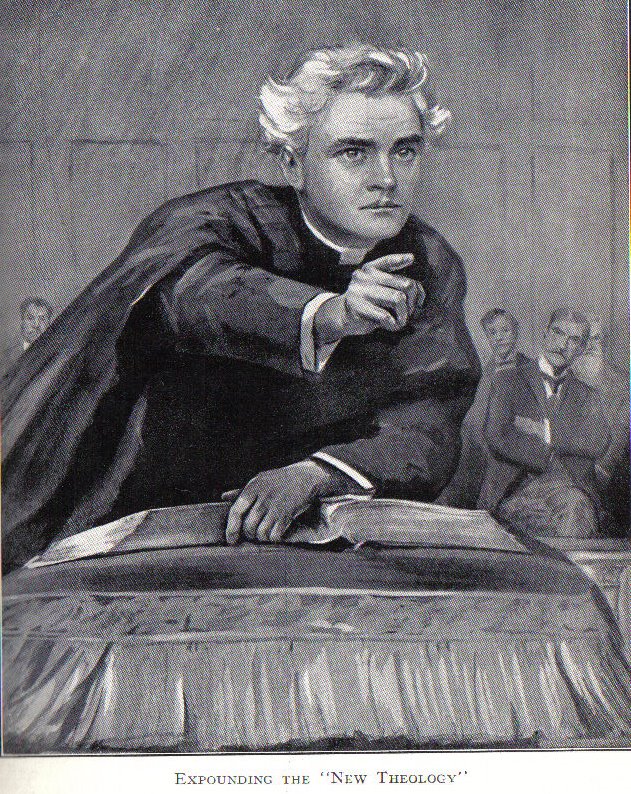
However, for many in the churches, political and social involvement under the auspices of Christianity prepared the way for an ideology that looked for the realization of God’s kingdom on earth through political action, in other words, Socialism.[1] Keir Hardie liked to declare that socialism was the realization of the Kingdom of God preached by Jesus,[2] echoing the words of R. J. Campbell (pictured), controversial minister of the City Temple, London, who declared: 'Our business is to show that the religion of Jesus is primarily a gospel for this life and only secondarily for the life to come.'[3] Jones notes that, in order to make such a statement, Hardie had had to distort the message contained in the Bible, something made easier by the new doubt in theology. Indeed, Hardie’s ideas owed a great deal to the ‘New Theology’ of R.J Campbell, a modified pantheism that saw sin as merely error and Christ as an enlightened man and example, as well as stressing social action.[4] For men like David Thomas, Chapel doctrine, so muddy and confused, became pointless, to be replaced by red-blooded socialist doctrine. If Christianity seemed to be in conflict with socialism, the message of the Gospels had to be changed, not the message of socialism.[5] And, slowly, God could even be written out of the picture, replaced by the message of Karl Marx.

[1] Robert Pope: Building Jerusalem: Nonconformity, Labour and the Social Question in Wales 1906-1939 (Cardiff, 1998) p.83-85; R.J Campbell, The New Theology (London, 1907): Pantheistic conception of God pp.18-21; Christ a man who ‘was divine simply and solely because His life was never governed by any other principle’ save love, pp.75-7. Sin human error in seeking after God, pp.160-2: The man who got drunk last night […] would be surprised if you were to tell him […] that he seeking God; but so it is.’
[2] In fact it appears that Keir Hardie was more interested in Spiritualism, Palmistry and astrology than orthodox Christianity. However, his appropriation of religious language allowed him to speak to the workers in a langauge they understood (Robert Pope, Jerusalem, p.9).
[3] R. J. Campbell, The New Theology, p.256. He also declared: ‘In fact, the Labour Party is itself a Church, in the sense in which that words was originally used, for it represents the getting together of those who want to bring about the Kingdom of God [R.J Campbell, The New Theology (London, 1907), p.255].'
[4] Pope: Jerusalem, p.14-15.
[5] Jones: Faith, p.410.

Labels:

Friday, September 01, 2006

The Decline of Welsh Nonconformity 8: Poltics.

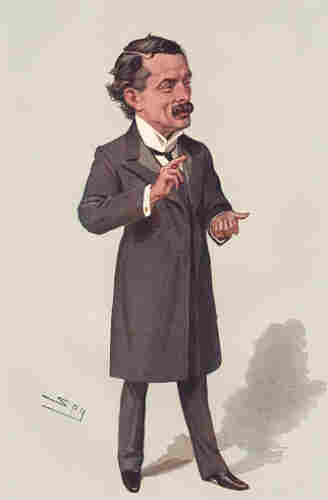
Welsh Chapels had fulfilled a political role since before the 'revolutionary' year of 1868, when newly-enfranchised Nonconformists had overturned the long-dominant county families in seats like Cardiganshire and Carmarthenshire. They had traditionally supplied speakers and candidates for the Liberal Party, in opposition to the Anglican-supported Conservative Party. The campaign for the disestablishment of the Anglican Church saw nonconformity even more closely involved with politics, with Nonconformist advocates like David Lloyd George (pictured) and John Herbert Lewis holding the 1894-5 Liberal Government to ransom over this. Nonconformists and churchmen clashed in print, with allegations dishonouring to the body of Christ being traded openly.[1] Besides this, there was also the question of social action, working to make the lot of the poor better. These came together with the rise of labour, and especially the rise of socialism. For those concerned with social action, socialism seemed to offer a better way of addressing social issues than the old individualism. For some socialists, it was easy to paint Liberal-supporting chapels as being no more than stooges for capitalism, stressing an inner piety that capitalists had little to fear.[2]

[1] While the early literature on Disestablishment and the woes of the Church in Wales was generally prepared to recognise fault on both sides, e.g. Judge Johnes' Inquiry into the Causes of Dissent in Wales, later literature, such as that of David Davies, Penarth (The Ancient Celtic Church in Wales) and anything by the Bishop of St. Asaph was far more confrontational. The reaction of Nonconformity to the final Disestablishment settlement was anything but gracious, and left an impression of vindictiveness.
[2] Cyril E. Gwyther: ‘Sidelights on Religion and Politics in the Rhondda Valley, 1906-26’ in Llafur (3.1) (Aberystwyth, 1980).

Labels:

Thursday, August 31, 2006

The Decline of Welsh Nonconformity 7: Doctrine (conclusions)

Of course, when looking at the rise of theological liberalism, it is easy to over-egg the pudding. There is a real difficulty in assessing the inroads made by the new ideas, since the propagandists of these ideas had a vested interest in exaggerating the spread of their ideas, often claiming lots of people secretly held these ideas, but were too afraid to speak out. On the orthodox side, many claimed that the laity were largely unaffected, another unprovable statement.[1] Certainly, however, doubt was greater among theologians and candidates for the ministry than it had been since at least 1730. Many took refuge in a faith that was subjective, looking within to experience rather than outwards to objective Christian truths (This tendency within the leadership Jones demonstrates by looking at the records of sermons between 1890 and 1914). With the reliability of many of the historical passages of the Bible in doubt, this should not be seen as a surprising development.[2] It was, and still is, far easier to side-step challenges than to meet them, but retreat from any salient, however exposed, can mean exposing one's flank to the enemy.


Appendix:

Percentage of sermons preached on portions of the Bible, 1890-1914:[1]

29% from Paul’s Letters (including Hebrews).
18% Matthew, Mark and Luke (although only 5% of these on the historical events in these Gospels).
14% John’s Gospel and Letters (including Revelation).
11% Psalms and the works of Solomon.
9% Prophets.
9% Historical books of the Old Testament.

[1] Jones: Faith, p.221.
[2] Jones: Faith, p.129-160.
[3] Source: Jones: Faith, pp.129-30. This information is based on a study of about 800 printed sermons. Clearly, this can only be a rough estimate, but since published sermons tend to be ‘the cream of the crop’, it is important as an indicator.

Labels:

Wednesday, August 30, 2006

The Decline of Welsh Nonconformity 6: Doctrine

As we have seen, the late nineteenth century saw a tremendous change. Darwinism in science, and new ways of reading the Bible, together with a sceptical approach in archaeology combined to create a climate in which things once certain were in doubt.

There were some, like Thomas Charles Edwards, who tried to combine these new doubts with the old certainties, hoping that, in so doing, they would preserve the central place of Christianity in the national culture. This, Jones and Sheehan both argue, did nothing but pave the way for further inroads of new ideas. Students at the theological colleges simply did not exercise the self-restraint their teachers had shown. Attempts to maintain that the theology of the Bible was essentially correct while the geography, science and history of the Bible were mistaken caused many to wonder how the unprovable assertions of the Bible could be correct when the provable ones weren’t. At the very least, religion could be discarded as having no practical relevance. In the words of a socialist writer: ‘A conception which has been discarded in the explanation of the making of the earth and the development of its inhabitants cannot be honestly retained to explain the social relations of men.’[1] In seeking to keep Christianity relevant, the theologians had undermined the foundations of the Church.

[1] Mark Starr, A Worker Looks at History (London, 1919), p.3.

Labels:

Tuesday, August 29, 2006

The Decline of Welsh Nonconformity 5: Doctrine

As had happened on the continent, some theologians, faced by the twin challenges of 'Higher Critical' scholarship and Darwinism, tried to take refuge in the belief that while the existence of God could not be objectively proved, His existence could still be maintained as the necessary foundation of moral life. The Bible could best be defended, in their view, as a book cointaining moral and religious truths, while erring in matters of science and history.[1] This position, modern evangelical historians such as R. Tudur Jones have argued, was not sufficient. Soon, even this foundation came under attack by men who backed up their arguments with scientific (or pseudo-scientific) ideas, such as Karl Marx and Ernst Haeckel.[2] For Bob Sheehan, the astonishing thing about these new ideas of uncertainty, which treated the Bible as just another book, to be questioned, criticized and reconstructed is that they were accepted by almost all leaders of nonconformity (in Wales this included Lewis Edwards and his son, Thomas Charles Edwards). By 1900, these ‘liberal’ and ‘higher critical’ ideas were taught in the Universities and most of the theological colleges in Wales.[3]

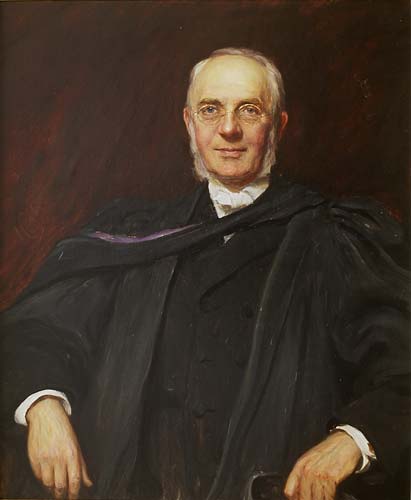
Thomas Charles Edwards, in his 1895 Davies Lecture 'The God-Man' attempted to reconcile orthodox Christian teaching on the person of Christ. While enthusastically endorsing the Virgin Birth and the deity of Christ, he introduced the idea of the incarnation as the pinnacle of human evolution (albeit an evolution issuing from the mind of God).[4] In Edwards' view, the incarnation would have occured without the Fall.[5] Most worrying to more conservative theologians was Edwards' apparent endorsement of a fairly radical kenoticism, in which Christ divested Himself of the form and many of the attributes of God, retaining little more than His divine personality. While Christ remained to him God, that great and good man had helped ease Welsh Nonconformity onto the Down-Grade.


[1] R. Tudur Jones, Congregationalism in Wales (Cardiff, 2004), pp.193-4.
[2] Jones: Faith, pp.196-198.
[3] R.J Sheehan: ‘The Decline of Evangelicalism in Nineteenth-Century England’, in The Banner of Truth (278) (Edinburgh, 1986) pp.15-17. See also W.B Glover: Evangelical Nonconformists and Higher Criticism in the 19th Century (London, 1954) and Davies: Light, pp.95 (Profile of Lewis Edwards).
[4] Thomas Charles Edwards, The God-Man: Being the “Davies Lecture” for 1895 (London, 1895).
[5] Thomas Charles Edwards, The God-Man: Being the “Davies Lecture” for 1895 (London, 1895), p.104.

Labels:

Monday, August 28, 2006

The Decline of Welsh Nonconformity 4: Doctrine

The period after 1870 saw great changes in the doctrine of Welsh Nonconformity, and in their view of Scripture. The largely Calvinistic doctrine of nonconformity in the 1850s, with its emphasis on the Sovereignty of God and the inerrancy of the Bible, was slowly replaced by a muddier doctrine that emphasized the Love of God and viewed the Bible as a human document containing errors of fact. By 1906, it was possible for theologians in the Calvinistic Methodist Connexion to confess themselves unable to name the five points of Calvinism.

In 1887, Baptist Minister Charles Haddon Spurgeon published a series of articles arguing that nonconformists were allowing ideas that conflicted with the historic belief of nonconformity to penetrate their churches.[1] In Wales, voices were heard agreeing with this belief. In 1901, Garmon Roberts, Gobowen observed: ‘Our age is an age of doubt.’[2] This doubt was over fundamental issues, such as the historical nature of much of the Old Testament, informed by evolution and developments in historical criticism.


[1] The articles can be found on the internet at
  • The Spurgeon Archive

  • [2] Quoted in: Jones: Faith, pp.193.

    Labels:

    Saturday, August 26, 2006

    The Decline of Welsh Nonconformity 3: Church Life - Preaching & Preachers

    R. Tudur Jones writes of ‘the Great Preacher’, a character admired almost universally. Yet the greatest were dead by 1890 and many sermons could be flippant, bordering on entertainment rather than instruction. Thomas Charles Edwards, educational leader and preacher, went on record attacking the affectation of many preachers.[1] Indeed, there was a danger of preachers looking to their own popularity, rather than the word of God. Tudur Jones cites the case of a meeting at Ffynnonhenri, Carmarthenshire, where one of two guest preachers went home after the morning service as the man who came after him had been better than him.[2] There were popularity contests held in religious papers,[3] and some men made their names imitating preachers. All this celebrity was not enough, however, to keep young men and students from embracing secular and rationalistic ideas. The content of the message, Francis Jones of Abergele complained, had become less important than its style.[4]


    [1] Jones: Faith, pp.123.
    [2] Jones: Faith, pp.124-5.
    [3] Y Cymro (1897) and The British Weekly (1907).
    [4] Jones: Faith, pp.128.

    Labels:

    Friday, August 25, 2006

    The Decline of Welsh Nonconformity 2: Church Life-the Church Corporate

    Nonconformist churches were places for social interaction as well as places for worship. Every church had a Sunday-school and at least one mid-week meeting, as well as special events like the Church breakfast illustrated. Analyzing the activities of nonconformist churches, R. Tudur Jones notes that most held meetings on every day in the week, one on Anglesey had as many as 15 meetings –more than two a night!

    Many of these meetings were not religious in character but more generally social-although every chapel did have its prayer meetings. There were activities as varied as debating and sports. Although the purpose of these activities was to bring people together and deepen fellowship, it was too easy for social activities to become a distraction from the main purpose of the church. Competitions such as debating contests could engender an unhealthy spirit of competition. Independent Minister John Thomas deplored the tendency to provide amusements for young people, declaring that: ‘A Bible class in one room cannot compete with the billiard table and the bagatelle board in another room.’[2] There was every danger of churches becoming merely social centres, vulnerable to the coming of bigger and better distractions. Jones agrees, stating that often:

    "[…] people began to identify Christianity with this kind of [social] activity. To such people the Christian faith was merely one facet of the Welsh-Language entertainment culture, and when a mighty tempest came to batter Welsh Christianity, they had not the strength to withstand its force."[2]

    A secularised, merely cultural Christianity, devoid of devotional feeling would not retain members when the social activities that kept them in the church could be found outside it.

    [1] Quoted in Jones: Congregationalism, pp.189.
    [2] Jones: Faith pp.97.

    Appendix: A Typical Chapel Week in Swansea (data relates to Libanus Baptist Chapel, Swansea).[3]

    Monday: Prayer meeting & Temperance meeting.

    Tuesday: Band of Hope & Christian Endeavour (Young People’s meetings).

    Wednesday: Seiat (Fellowship and prayer meeting).

    Thursday: Sisterhood Prayer meeting & Choir Practice.

    Friday: Bible Class.

    Saturday: Men’s Prayer Meeting.

    [3] Source: R. Tudur Jones: Faith and the Crisis of a Nation: Wales 1890-1914 (Cardiff, 2004) pp.89.

    Labels:

    Thursday, August 24, 2006

    The Decline of Welsh Nonconformity 1:

    As the year 1900 dawned, nonconformist leaders in Wales could be forgiven if they surveyed the landscape with an air of satisfaction. The preceding century had seen great advances for nonconformity. Wales had cast off the established church and embraced democratic nonconformity with astonishing vigour. No wonder Thomas Rees, Principal of the Congregationalists' Brecon Memorial College was moved to declare:

    "No children of any century will be prouder of their flag nor louder in their praise to Him who ordains the times and seasons than those of the nineteenth century [...] but the twentieth century will be yet more privileged.’[1]

    Others sounded a more cautious note, but it would have taken a very great pessimist to have forecast that by the year 2000 Wales would be a nation of closed chapels and dwindling congregations, Christianity reduced to no more than a private hobby. Looking back, many have declared that by 1900 the nonconformist citadel was already crumbling, its foundations undermined from within and without. A recent popular (2002) history of Welsh Christianity declared:

    ‘[…] while the [nineteenth] century had begun full of hope, and the Golden Age in the first half of the century had seen that hope increasingly realised, the true situation in 1900 was very different. The outward shell seemed in good condition, but in reality there were serious problems at the heart of the faith in Wales.’[2]

    Yet the years leading up to 1914 can hardly be described as barren. In the Calvinistic Methodist Church, the Forward Movement of John Pugh and the Joshua brothers was reaching English speakers in South Wales to an astonishing extent.[3] In 1904, there was a great revival which swept Wales from end to end. How, then, is it possible to speak of nonconformity being in decline in the years prior to 1914?

    Congregational historian R. Tudur Jones, in his book Faith and the Crisis of a Nation makes just this assertion. In Jones’ work, this decline is described as an attack upon the foundations of nonconformity which left it unable to cope with the storm of 1914 and the years that followed.[4] The factors behind this decline may be grouped into three areas; Church Life, Doctrine and Politics.

    [1] Quoted in: R. Tudur Jones: Faith and the Crisis of a Nation: Wales 1890-1914 (Cardiff, 2004) p.2.
    [2] Gwyn Davies: A Light in the Land: Christianity in Wales 200-2000 (Bryntirion, 2002) p.94.
    [3] See Geraint Fielder: Grit, Grace and Gumption (Fearn and Bryntirion, 2000).
    [4] R. Tudur Jones: Congregationalism in Wales (Cardiff, 2004) pp.219.

    Labels: