Thursday, July 13, 2006

The Church & Young People 6: A Word on 'Methods'
I had meant yesterday's post to be the last in this series on 'The Church and Young People,' but a comment from jen_est caused me to ponder her very important questions:

1."Do you think that being in a church-going society does affect the way we do these things?"

It is important to realise that neither Sandfields nor Heath were located in areas where church-going was 'normal.' They were mission churches. The worldly activities they turned away from were the result of a society which saw church-going as a social activity. People were going to Church, especially the meetingsin the week, for social reasons. When entertainment fashions changed, the churches emptied. The same was true of youth meetings, as we saw in our third example. That said, Sunday-school was then seen as normal, and there was greater general Bible knowledge than there is today. The Church must deal with the cultural context in which it finds itself, although not in such a way as to compromise the Gospel.

2. "Had MLJ or JWOwen lived in say, China, where Evangelical Christianity is persecuted, would they have adopted any of these "methods"?"

We should note that Martyn Lloyd-Jones distrusted methods. Had he been allowed his way, he would have discontinued all meetings apart from the Lord's Day meetings, the Bible Study and the Prayer-Meeting, relying on the Holy Spirit alone. J. W. Owen's work, with its emphasis on Christian fellowship, was designed to deepen Christian fellowship, in the tradition of the Calvinistic Methodist 'Experience Meeting'. While it is impossible to know how a thing might translate into a different cultural setting, it seems to me that a Christ-centred youth work, dependent on the Holy Spirit is more easily transferable than activities heavily dependent on culture.

However, in the final analysis, the Church of Christ does not advance by methods, but by the Holy Spirit. Both J. W. Owen and Martyn Lloyd-Jones were aware of this, and would have confessed that without Him they would have achieved nothing. And we must bear this in mind today, as we seek to reach out to an increasingly God-hating world.

Labels:

Wednesday, July 12, 2006

The Church & Young People 5: Concluding Thoughts

I have presented three examples of the attempts to churches to dealwith young people. Lloyd-Jones at Sandfields ended the membership candidates' meeting, believing that this was producing false conversions, and expected young people to take a full part in the normal activities of the Church. J. W. Owen at Heath re-orientated the activities of young people towards spiritual, rather than material things, the centrepiece being a fellowship meeting on Saturday evenings for prayer and testimony. Portland Street Congregational Church provided leisure activities for their young people. What conclusions can be drawn from our study?

While Lloyd-Jones ended young peoples' activities, I am not sure that this was not over-reaction. Having been received into membership at Llangeitho while yet unconverted, Lloyd-Jones was only too aware of the danger of producing false professions, as well as the danger of falling prey to modern psychological techniques. While Lloyd-Jones could do this, however, it seems to me that J. W. Owen's answer was closer to being correct. Young people could organise games outside the church's time, but the church's provision was focussed on things that are above. Even if Portland Street's table tennis table and billiards table had not been deserted for pop records, it is impossible to imagine games and hikes producing pastors, missionaries and evangelists, or even regenerated church members.

The desertion of the games provided by Portland Street must also be examined. The deacons had provided what they felt young people wanted. And, while that fashion lasted, the rooms were full. However, once the fashion changed, the rooms emptied. All youth work has its ups and downs, but we can be assured of this one thing. The Holy Spirit will never go out of fashion, and it is He that must be truly leader of our young people.

Labels:

Monday, July 10, 2006

The Church & Young People 4: Portland Street Congregational Church

In this series on the Church and Young People, I have thus far looked at the attempts of two Calvinistic Methodist Churches to deal with the slide towards an emphasis on entertainment and recreation in their work amongst young people. In this section, I intend to present a church which continued down the road of recreation and entertainment. That Church was Portland Street English Congregational Church, Aberystwyth.

Founded in 1866 to cater for the growing English presence in the town, the church was anxious to secure its future by retaining its youth. In November 1924, a 'Young People's Society' was formed. Meeting every Monday evening, the programme was decided by the young people themselves. To start with, the meetings consisted of singing and games, but later lectures and devotional meetings were added. Mixed dancing was allowed by the deacons for the group's socials. This Society continued until the outbreak of war in 1939 forced its dissolution.

In the early 1960s, a further attempt was made to attract young people. In the words of local historian and member, W. J. Lewis:

'Time and money were spent on equipping one of the basement rooms for table
tennis and another for billiards. Hikes and other activities were arranged and
for a while the movement thrived. Then came the pop song, record sessions, and
the twist, and the basement rooms were soon almost deserted, but the club is
still in existence (W.J Lewis, The English Congregational Church, Portland
Street, Aberystwyth 1866-1966,
pp.73-4).'

The club is no longer in existence, Portland Street Church having amalgamated with St. David's Presbyterian Church in Bath Street. The basement rooms are now used by a theatre company, while the church building is a doctor's surgery.

Labels:

The Church & Young People 3: Heath, Cardiff

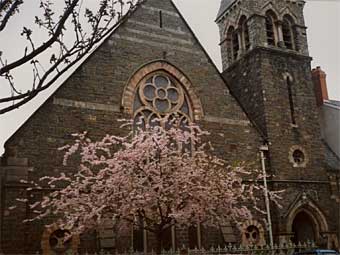
Like Bethlehem, Sandfields, Heath Church, Cardiff, was founded by the Forward Movement of the Calvinistic Methodists. The building illustrated was erected in 1906. Like Sandfields, the church had passed through testing times in the 1920s, when the church had experienced financial difficulties, coupled with a period of three years without a pastor, which ended in May 1930 with the induction of J. W. Owen, a former missionary with the China Inland Mission.

Like Dr. Lloyd-Jones, J. W. Owen was anxious to uphold high spiritual principles, worried about the growth of social and recreational activities, which had come to overshadow the spiritual witness of the Church (Leighton Hargest (ed.), Holding Forth the Word of Life (cardiff, 2000), p.19. While Lloyd-Jones had discontinued activities for young people, the work of J. W. Owen saw a new wind blowing through the work among young people.

During J. W. Owen's ministry, the Manse in Allensbank Road was used as the meeting place for the 'Penrhyn Circle' (J. W. Owen had been Pastor at Penryn Bay before his call to Cardiff). This was a meeting 'of young people for prayer, testimony and fellowship (Hargest, Holding Forth, p.20).' The result of this was a spiritual awakening in which many young people were greatly blessed and enabled for Christian service, at home and overseas. The Saturday Manse meeting would resume under the Ministry of W. Vernon Higham and see similar fruits. Today, under Wyn Hughes, the meeting, led by Keith Batstone is smaller than it has been in the past, but it continues, and with it, the blessing of God.

We have looked at two options for young people's work. The first, under Lloyd-Jones, saw young people treated as nothing special, part of Lloyd-Jones' belief that young people were being sought in a worldly way. J. W. Owen belived that young people should fellowship together in order to grow spiritually. Tomorrow, we shall look at the third option, the one away from which Lloyd-Jones and J. W. Owen had turned.

Labels:

Saturday, July 08, 2006

The Church & Young People 2: Sandfields

Bethlehem Forward Movement Mission was founded in 1897 by John Pugh's Forward Movement, an organisation for the evangelisation of the unreached English-speaking masses of South Wales. Built in the rapidly expanding town of Aberavon, it was designed to minister to the souls of ordinary men and women. By 1927, the Mission had gone through seven pastors and one 'evangelist', with varied results. The work among young people had come to be conformed to the pattern of the world, with an amateur dramatic group, football team and all of what had become the normal features of young people's work in inter-war nonconformity.

It was to this situation that Dr. Martyn Lloyd-Jones came in February of 1927, an object of some curiosity due his decision to leave his medical career for the ministry. Among his first actions was to discontinue the meeting for young people wishing to join the church. Lloyd-Jones felt that this was spiritually unprofitable, leading to the confusion of conversion with Church membership, and both with coming into teenage years. This, Lloyd-Jones believed, led to a wrong concentration upon 'the young people' to the exclusion of those 'old in sin.' "Concentration upon the young", he declared, "is a large part of the genius and success of Roman Catholicism, but surely it is the very antithesis of the genius of Protestantism. It is one thing to produce a religious man - men can do that - but it takes the power of God in Jesus Christ to produce a Christian man, and there is no limit to that power."

The stage in the church hall was sold to the YMCA, as the amateur dramatics were discontinued, along with the Band of Hope, a young people's organisation devoted to teetotalism. Lloyd-Jones wanted no distractions from Christ, whether in entertainment or morality. The result was at first the awakening of the Church, then a revival which touched the district, men and women being saved out of deep sin. Although all means for attracting those who had no interest in 'Church' had been dropped, the Church grew by the preaching of the Word alone.

On Monday, we shall be looking at another Forward Movement Mission, Heath Hall in Cardiff, and the reforms to the young people's meeting undertaken by the Rev. J. W. Owen. Tonight and tomorrow I shall be worshipping where he and they worshipped, enjoying the benefits of the faithfulness of the people of Heath Evangelical Church.

Labels:

Friday, July 07, 2006

The Church and Young People 1: 'To Whom Shall We Go?'

In the past few weeks, I have become acutely aware of a problem facing the Church in the modern age. The problem of what to do with young people. Children are dealt with in Sunday-School, as has been the case for many a long year. However, there is a problem, throughout the Western World, Children who have gone through Sunday School drop out of the Church as young people. In an attempt to hold onto them, churches have organised activities for them.

However, some disquiet has been raised about the content of activities. Are they too worldly, youth leaders acting as though they were running a secular youth group? Or are they designed without consideration for the special needs of young people?

In this series, I shall be examining the responses of four Welsh churches to this question. My focus will be on the upper end of the 'Youth' category, what was once meant by a 'Youth', that is, a person on the cusp of adulthood, as it is here in particular that serious falling away can take place. We shall start with a famous example, Bethlehem Forward Movement Church, Sandfields, Aberavon.

Labels: