Thursday, December 14, 2006

Dr. John Alexander of Norwich: Conclusion.


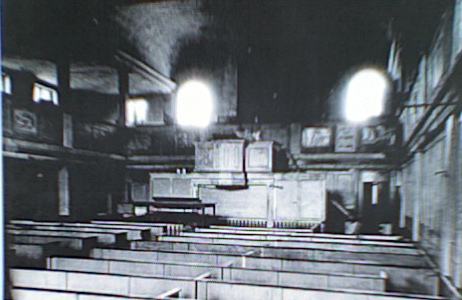
Princes Street Chapel today


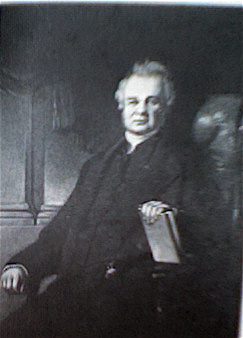
Dr. John Alexander began his ministry in 1817 and died in 1868. Can we learn from a man who lived so long ago? Those who read this blog regularly know that we answer emphatically yes!

So what can we learn?

1. A godly heritage is an excellent thing. John Alexander is an eminent example of this, seeing that his father was known as 'the Lancashire Apostle.' Yet William Alexander did not neglect his family. He was a pastor to his son, as well as to his congregations. More, he was a father with a real concern for his children.

2. The need of a true conversion. John Alexander actually got into a fight about the truth when he was a boy, but he had no heart knowledge of it. Mere intellectual knowledge may make a bigot, it cannot make a Christian.

3. The centre of a true Gospel ministry is the Lord Jesus Christ Himself. John Alexander was guided by his father's advice in this. When the man they called the Lancashire Apostle wrote, "I say, John, preach Christ. Don't say Christ is not in the text; He is in the Bible; that will do. Put man down, put Christ up," he set the note for a lifetime's ministry that built a thriving, working, missionary Church. No other message will build a church. It may bring people together, it may do a lot of things, but it cannot build a Church of the Living God. Both William and John Alexander saw this and laboured to preach 'Christ and Him crucified.'

4. The importance of Church order. The Tabernacle was wrecked because there was no clear church order, and so two competing claims could arise concerning the right to elect a pastor. John Alexander saw the need for church order and insisted that any church he pastored must have a clear structure of authority. He was also persuaded of the congregational system. A proper church order in the constitution of a local church will be a check on the ambitions of the few.

5. God knows our path, we do not. When he was in the Hoxton Academy John Alexander saw his future as the pastor of an existing church, yet he was in fact called to found a church and to build it up practically from the ground. It was the last place he would have seen himself, yet that was what happened!

6. Independency is not isolationism. John Alexander believed fervently in independency. When he founded Princes Street he could have chosen a Presbyterian model of Church government, but he felt that Independency was the Biblical model. Yet he cultivated relations with the other Reformed churches in the city, the Particular Baptists and the Old Meeting. Later in life he was a member of the Congregational Union. Yet all of his formal inter-church relations were on the basis of truth, not of feelings. All were strictly voluntary. Incidentally this decision for the truth meant that Kinghorm would not allow Alexander to partake of the Lord's Supper, yet viewed him as once of his closest friends.

7. The importance of young pastors having fellowship with older, more experienced pastors. When he first came to Norwich Alexander was mentored by Joseph Kinghorn. Later he would mentor Kinghorn's successor. His co-pastors were all welcomed into the family, and pastored by the senior pastor. The 'Paul and Timothy' relationship he had with Mr. Prout is another example of this.

8. A healthy church is a working church. There were no non-workers in Princes Street in Alexander's day. The church young people assisted in Sunday-schools, and there were intensive efforts to reach out with the Gospel. Young men who evidenced preaching gifts were encouraged to excercise them. The church is an army, and there are no spectators in an army.

9. A love of the Gospel ought to lead to philanthropy. Dr. Alexander's greatest concern was always for the Gospel, but that did not prevent him from involvement in practically every charitable and philanthropic project in the city. It was Christian men like him, not Deists or Unitarians, who led the call to abolish slavery. Christians ought to be the greatest supporters of charitable causes, where those causes do not compromise the Gospel.

10. The true servant of Christ will be tried. The financial situation of the church was always a worry to Dr. Alexander, and when the debt was finally paid off he was a happy man. The Tabernacle controversy was another major trial to him. Yet in all these things he was more than a conqueror through Christ.

11. Calvinism is no bar to evangelism. John Alexander swerved not one inch from the Calvinism of the Westminster Shorter Catechism, and thousands were converted through his ministry. He planted two churches in the Norwich suburbs, and his church sent missionaries to foreign fields. William Alexander was a flaming preacher, whose ministry was blessed to the conversion of thousands, and he was the man who taught John Alexander his creed. Both of these men saw that Calvinism and evangelism go together.

11. Finally, John Alexander was not a remarkable man. He had a remarkable Saviour. And that Saviour is my Saviour. Is He yours? As J. J. Gurney would tell us, "Praise the Master, not the servant." And praise the Master by turning from sin to serve Him.


What happened at Princes Street after Alexander? Well, they called another pastor, G.S. Barrett. But Barrett faltered on the question of inerrancy. The church is a URC now, and quite liberal. I have only once been to a service there, and once was enough. The minister (not the present one, but his predecessor) said that 'Christians ought to reverence Mohammed more.'
Write 'Ichabod' upon the doors. The Glory has departed. But Christ still lives today, and He is still preached in Norwich.

Labels:

Wednesday, December 13, 2006

Dr. John Alexander of Norwich: X.

John Gill said that he found no warrant in Scripture for co-pastors. We disagree, we think that those passages which speak of a single church having many elders are warrant enough. When Dr. Alexander's first assistant resigned to become a missionary in China, the church called Rev. Edward S. Prout, one of Turner's fellow students. Prout was warmly welcomed into the church and into Dr. Alexander's own home. Pastor and co-pastor in fact became so close that they were known as 'Paul and Timothy'!
Prout's ministry began in October 1859, and for three and a half years he and Dr. Alexander were inseparable. Although he had been the founding pastor of the church, and sole pastor for forty years, Dr. Alexander wisely saw that as his ministry drew towards its close, he could no longer do unaided what he had done for so long. Prout wrote:
"My relations to my beloved colleague during the three-and-a-half years of my co-pastorate were those of unalloyed happiness. Not a shadow clouded it. Though ripe in years, he had a very youthful heart. He was full of humour, and his repartees often sparkled with wit."
The church also had several members, young men converted under Alexander's ministry, who were themselves called to the ministry. Dr John Stoughton, the noted historian and minister, Rev. J. A. Gurney, who ministered in Jamaica, and many others. And they had before them the example of a laborious and faithful pastor.
Thomas Binney, known to most of us from his hymn, 'Eternal Light! Eternal Light!', called John Alexander 'Saint John', and now, the elder statesman of Norwich Dissent, John Alexander bore some resemblance to the aged apostle. In February 1866 he resigned from the pastorate of the church that he had founded, knowing that he was no longer able to be the pastor he had been. At first he was tempted to despair, finding that he was no longer pastor, but God led him into green pastures, and he was still able to preach until within a few months of his death.
As, in 1868, his health began to fail, it was the strong Calvinism of the Westminster Confession, the creed he had learned as a boy, that kept him. He never forgot his father's warning 'preach man down and preach Christ up," and as he lay dying he spoke often of Christ, "Oh, what should I do without Him?"
Dr. John Alexander of Princes Street Congregational Church, Norwich, died on July 31st 1868, aged 75. Although sermons were preached at his funeral they followed the advice Joseph John Gurney had given Alexander when he preached the funeral service for Joseph Kinghorn, "Praise the Master, not the servant."
Fittingly one of his own converts, Dr. Stoughton, preached the funeral sermon, in St. Andrew's Hall, as Princes Street was being almost totally rebuilt at the time. The huge building was packed. Where was his memorial? It was in the pulpit, a young man called to Christ through Alexander's ministry. It was in the seats below, hundreds of men, women and children who could say that Alexander was their father in Christ.
And so there was only one epitaph for Dr. Alexander: Well done, thou good and faithful servant." We can be sure that he entered into the rest of his Lord.

Next time, God willing, we shall draw some lessons from the life and ministry of Dr. Alexander.

Labels:

Tuesday, December 12, 2006

Dr. John Alexander of Norwich: IX.

Dr. John Alexander was a great man, not by worldly standards, but by Christian standards. His father had taught him what made a true pastor, and he had seen first hand what a man of God looked like. Upheld by the grace of God he was used to establish and to build up a large, active, missionary-minded church in the city of Norwich. While Norwich was declining in importance at that time, it was still (as it is today) an important city and the centre of the county. He was a congregationalist to the very core of his being, yet he enjoyed fellowship with evangelicals of every denomination, including Anglican and even Quaker. Under his leadership Princes Street planted churches in villages around the city and educated the children of the poor.
Dr. Alexander was a true philanthropist, a lover of men. For not only did he establish schools and throw himself into such causes as the abolition of slavery and the improvement of conditions in the prisons, not only did he care for the bodies of the poor, but he cared for the souls of all, rich or poor, and he did not shrink from proclaiming to the city the everlasting Gospel of Christ crucified in the very room and stead of sinners.
His wife (the date of his marriage does not appear in my sources) was such a wife as a pastor of Dr. Alexander's fervour needed. She ran a joint ladies' meeting with the Old Meeting House (congregationalism has never meant isolationism).

In 1841 Alexander's health, taxed by years of hard labour on behalf of his Lord, gave way. He was taken ill on March 26th and the deacons ordered him to take a vacation - they knew that he would get no rest if he stayed in Norwich, as the whole city was his sphere of work. He traveled in the south of England and in Lancashire until mid July, when he returned.
The deacons knew that Dr. Alexander (as he now was) had fallen ill because of overwork, and they decided to reduce his workload by having the Lord's Day evening service taken by visiting supplies. Not that Dr. Alexander's preaching load on the Lord's Day was halved, as before 1841 he had taken three services in the church, one in the morning, one in the afternoon, and one in the evening.
In 1847 a great meeting was held in St. Andrew's Hall, the nave of the old Blackfriars' church, to celebrate the thirtieth year of Dr Alexander's ministry in Norwich. The church presented him with £400 - which he immediately gave back to the church to pay off the remaining debt on the buildings!
The people thanked God for Dr. Alexander's 'constant and faithful devotedness to the work of the ministry and the welfare of his people.'
Ten years later, celebrating Dr. Alexander's fortieth year in the ministry, the deacons felt it wise to call an assistant. The Church meeting agreed, and in 1857 Mr. F.S. Turner, a ministerial student at New College, was appointed assistant. He was a valued co-worker, and Dr. Alexander and the membership would have called him as co-pastor, but Turner's heart was set elsewhere. He felt the call to missionary service in the Far East, and he left the church to preach Christ and make Him known where idols held sway. He went from Norwich to China, with the prayers and blessings of the Princes Street Church going with him.

A working church indeed! Next time, God willing, we shall look at the last years of Dr. Alexander's ministry.

Labels:

Thursday, December 07, 2006

Dr. John Alexander of Norwich: VIII.


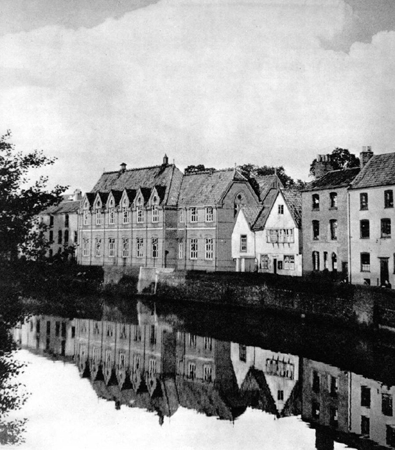
Not only was John Alexander concerned with reaching the city of Norwich and its outlying settlements, founding Sunday Schools and chapels, but he encouraged an interest in foreign missions in his church. From the beginning of the church there were members who contributed to foreign missions, and in 1833 the Princes Street Auxiliary of the Norfolk Missionary Association was formed. Often meetings of the Norfolk Missionary Association were held in the chapel. A huge platform would be set up for the representatives, level with the pulpit. Missionary breakfasts were held in the Assembly House (illustrated).
Although taking the Gospel to the heathen in lands where it was still unknown was a priority, as migration to the colonies increased it became clear that there were white settlers who were as much without God as the natives whose lands some of them were taking. Men and women leaving England were also leaving Christianity. Alexander took great interest in colonial missions, and when he was chairman of the Congregational Union in 1853 he made a special plea for this work, as the tide of emigration had swelled to thousands leaving every week.

And Mr. Alexander did not confine himself to his own church's activities, vast though they were. He took an interest in the life of the city, especially in religious, philanthropic and educatonal movements. We must remember that this was before state provision of education, and no-one at that time could even have imagined a National Health service. Alexander was for a time chairman of the board of the Norfolk and Norwich Hospital.
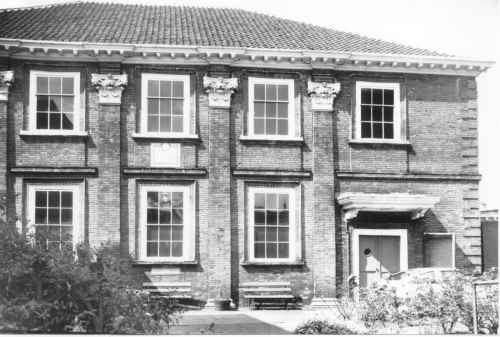
Norwich Dissent grew in influence in the 19th century. Buildings like the Old Meeting House, the Octagon Chapel and the old Gildencroft Quaker meeting-house (illustrated. Sadly destroyed by bombing in WWII. Some Quakers felt the Germans hit the wrong meeting-house) show that it had been wealthy before, but never to the extent it was to become. Alexander's unflagging efforts for his church and the wider church and community earned him a respect unusual for dissenting ministers in the period. One day he might be dining with the Bishop at the Palace, the next with the Quaker bankers, the Gurneys. And yet the man who was to be seen among the great and the good would also be seen without fail visiting the destitute and the bereaved.
Among these great and good, of course, were many philanthropists, such as Sir Thomas Fowell Buxton, Bart., the anti-slavery campaigner whose crusade against slavery was enthusiastically supported by Alexander and his congregation. The Quaker Gurneys were also great philanthropists, so we ought not to think that Alexander was just hob-nobbing with the wealthy - he was helping them in schemes to improve the city, the country, and the world.

Alexander also kept up good relations with the other ministers of the city. Mention has already been made of his dining with the Bishop, Bishop Stanley, who admired the congregational pastor's energy (inherited, one suspects, from his father), but he was also on good terms with Joseph Kinghorn, the Strict Baptist pastor of St. Mary's, whom he called, "A wise counsellor, a holy example and a faithful friend."
Kinghorm's successor, William Brock, was also a friend of Mr. Alexander's, and unlike Kinghorn was willing to admit Alexander to the Lord's Table. Indeed, there was a period when Willian Brock, John Alexander, and Andrew Reed, pastor of the Old Meeting, lived within a few doors of each other, and the three ministers would always be calling on each other. Those were great days for Norwich dissent. The three ministers all held to the same creed, barring differences concerning baptism, and there was a true fellowship between them. By this time Alexander was growing older, and the two younger pastors looked up to him as he had looked up to Kinghorn.

So he moved from being the new pastor to being the old prophet of Norwich dissent. God willing next time we shall consider some of the events of his later years.

Labels:

Tuesday, December 05, 2006

Dr. John Alexander of Norwich: VII.

John Alexander had almost resigned over the Princes Street debt crisis, but the deacons had been able to manage the debt. Or so they thought. Within three years the cheap construction of the chapel was starting to show. The joiners responsible for the roof had not been competent to span such a large space without any internal supports, and the church was forced to spend more money to make the roof safe. Until it was the chapel could not be used. The congregation were homeless again.
Yet the event was overruled for good. Not only was the Lancastrian School still available for Lord's Day meetings, and the French Church for week-night meetings, but the representatives of the older evangelical nonconformity in Norwich came to the aid of the congregation. The Old Meeting House, their sister congregational church, offered its building (pictured) for some services, and they and the Particular Baptists meeting in St. Mary's Chapel (named for its location across the street from St. Mary's Coslany) gave a substantial love-gift of money to help meet the unexpected expense. The chapel was reopened on March 16th, 1828.


As has already been mentioned, this was not the last time that the shoddy construction work of the original Princes Street chapel forced the congregation to vacate it while the building was repaired. They used a number of buildings including the Dutch Church, the old Blackfriars church that had been given to the congregation of Dutch refugees by the city. The Dutch Church itself, due to the assimilation of the descendents of the 'Strangers', as they were called, into the native population, was nearly extinct, and the building was used, as it is today, as a public hall. It meant that the church could meet together much closer to their own building, for Princes Street runs past Blackfriars. Alexander remembered that, while the Princes Street congregation were worshipping in the Dutch Church, they had sermons from ministers belonging to almost every evangelical denomination.

In 1820 Mr. Alexander had started a Sunday School in 1820. Like all Sunday Schools of the period it was not only an instrument of Christian instruction, but it was an instrument for increasing the literacy of the children of the area. Alexander took an active role in the running of the schools, saying at one point that they were "his solace in adversity, and one of his chief joys in prosperity." The children loved their pastor, because he was THEIR pastor, not just pastor to their parents. He distributed sweets personally during his visits to the schools, and the children concluded that pastor had an inexhaustible supply of them! Many former Princes Street Sunday-scholars treasured gifts sent to them by the pastor.
Until 1861, when a building was erected to house the Sunday School, classes were taught in the chapel between services, no doubt a rather inconvenient system.
Mission schools were set up in the city, one at Thorpe, one at Pockthorpe one at Trowse, and one in Mariner's Lane. All the young people of the church were either scholars or teachers in the Sunday Schools.
Alexander also had some gifted workers, and Princes Street became very much a working church.

God willing, next time we shall continue our seris on Dr. Alexander (as he became) and his church.

Labels:

Wednesday, November 29, 2006

Dr. John Alexander of Norwich: VI.


Since John Alexander was an unmarried man, the provision of a chapel was the first priority for the seceders from the Tabernacle. Regrettably the only pictures we have of the Tabernacle come from the end of its life, when it was badly maintained, and soon to be pulled down. They give no impression of its solid beauty. Designed by one of the greatest architects ever to work in Norwich in the 18th century, it was the sort of chapel no congregation would want to leave. But leave they had to.
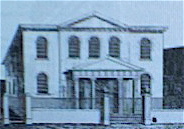
The chapel in Princes Street (pictured) was nothing out of the ordinary. Some of the rooms behind the building, used as vestries and school rooms, were retained from the buildings that had previously occupied the site.
The chapel was described by a local paper as "a plain, heavy-looking structure, destitute of architectural pretensions." The 'gothick' glazing in the windows seem to give the lie to that. Pretensions there were, just modest ones.
Capacity was one of the first concerns. The building seated 1'000, with galleries around three sides. It cost £4,838 8/8, including the site and the cost of demolition. That did not of course include John Alexander's salary. The congregation, although large, was not wealthy, and at the time all of them would have to have paid a tax to support the Church of England as well as supporting their own church (the Church Rate was abolished in 1868).
Buildingproceededd quickly, and by the end of November the new chapel in Princes Street was ready (it was later discovered that one of the reasons for this swift construction was that corners had been cut, and less than ten years later the chapel needed repairs. In 1868 the building was completely reconstructed).
The last service in the Lancastrian School was held on November 28th, 1819, and on December 1st, the following Wednesday, the chapel was officially opened by Rev. Dr. Raffles from Liverpool (no relation to the amateur cracksman). Thus 'PrincesStreett' became synonymous with the chapel and its people.
A church was formally constituted soon afterwards, and the first meeting of that congregational church was held on March 18th 1820, chaired by the Rev. W. Hull, pastor of the Old Meeting House Congregational Church, the oldest dissenting church in Norwich and the Rev. Alexander Creak of Great Yarmouth. Mr. Alexander wasreceivedd into membership from Bethesda Congregational Church, Liverpool, then the new church partook of the Lord's Supper for the first time. At the next meeting the newly formed church called Mr Alexander as minister, and he was ordained on May31st 1820.
All was not perfect, of course. For one thing the church had been forced to borrow money to build their chapel, and now the debt on it was a major source of worry. Indeed, the situation became so bad that in February 1825 Alexander wrote a letter of resignation and sent it to the church. It was never opened. The deacons, working tirelessly, managed to come to an agreement with the creditors to liquidate the debt of about £900 within five years. The cloud was lifted.

But all was not well. Another trial was about to strike. What it was we shall see, God willing, next time.

Labels:

Tuesday, November 28, 2006

Dr. John Alexander of Norwich: V.


Following the court case that decided the trustees of the Norwich Tabernacle had the sole right to appoint a pastor to the church meeting there, John Alexander had returned to London. However he was soon back in Norwich. A large number of members seceded from the Tabernacle Church, and they wanted to call Alexander as their pastor.
At first he refused. He was a young man, not yet twenty-five, and the idea of his first pastorate being in a new church where he would have to organise the Church on congregational lines and build a chapel was hardly inviting. He had been asked to preach at Kidderminster, and he felt that the church there would be more settled.
God and the people who had seceded from the Tabernacle had other ideas. Many of the seceders were descended from Dutch and Huguenot families who had fled to Norwich to escape persecution in the sixteenth and seventeenth centuries. They had inherited their forefathers' determination, and they were determined to have John Alexander as pastor. Finally, feeling that this insistence from godly men and women was a divine call, he accepted, on two conditions. Firstly, the new chapel must be built away from existing dissenting chapels, since he had no interest in sheep-stealing, and secondly that the new church must be organised on strictly congregational lines. Not even the possibility of the congregation being overruled in their choice of a pastor must exist.
The people agreed, and in January 1818 John Alexander returned to the city where he would spend the rest of his ministry, and where at length he would lay down both his labours and his life.
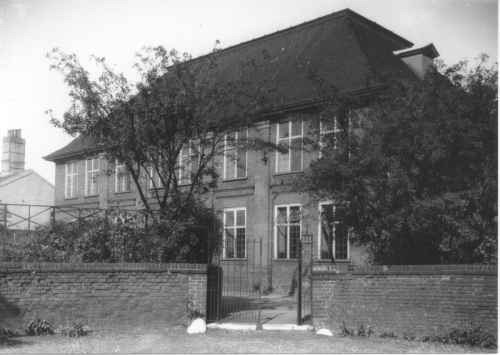
The meetings of the new church (not as yet formally constituted) began on 25th January at the Lancastrian School, Quayside (pictured). Week-night services were held in the French Church (also pictured. You can tell which is which).
The young Mr. Alexander thus began his ministry with neither chapel nor manse, but with a devoted, enthusiastic people. Crowds thronged the school, listening to a young man with jet-black hair preaching from an improvised pulpit. The uncertainty that had at first led him to decline the call was gone. This was the will of God, he was where he was meant to be, and that gave him boldness to preach the gospel. How the old 'Lancashire Apostle' must have thanked God for a son who was being used to bring so many to the Lord.
One of those men was John Stoughton, later a noted minister and historian of dissent. "How the people used to crowd and hear him," Stoughton would say years later, thinking of those days in the Lancastrian School and the French Church.
Of course the church began at once to look for a site further away from both the Tabernacle and the Old Meeting in nearby Colegate. There were many difficulties, but one was found in Princes Street (also known as Hungate Street), behind the church of St. Michael-at-Plea and facing the Church of St. Peter, Hungate. On March 16th 1819 John Alexander laid the foundation stone of the new chapel. He preached and the people sang the 117th Psalm.
The congregation was here to stay, and Princes Street was to become a name linked to that of John Alexander.

Next time, God willing, we shall look at the early years of the church at Princes Street.

Labels:

Monday, November 27, 2006

Dr. John Alexander of Norwich: IV.


Being a theological student is and has always been, a serious and often daunting business. Traveling to engagements often uncomfortable, even in our days of heated railway trains and cars. In early 1817 it was wretched. A cold, comfortless journey in the Day Coach was made worse for John Alexander when he spoke to a fellow-passenger and said he was going to preach at the Tabernacle with a view to becoming their pastor. At once he was regaled with the well-known stories of the problems at that church (an experience by no means uncommon today, but now the student must wait until after the service). Alexander was horrified. What sort of a place was he going to preach?
A few miles out of Norwich they were informed that the Mail Packet, the other route from London to Norwich (a fast steamer running between London and Great Yarmouth) had suffered a terrible disaster, the boiler having burst just as it was starting, killing eleven passengers.
Arriving in Norwich late in the day, John Alexander went straight to the house of the minister, who was an old man and close to retirement, only to find that the minister and all his household had already gone to bed! What was worse, the old man refused to let him in! Alexander not unnaturally considered taking the next coach back to London. If this was the sort of hospitality students got from the Tabernacle's pastor, what would the people be like?
But he stayed. On Lord's Day morning he mounted the high pulpit (pictured) of the Tabernacle and gave out his text.
"But we see Jesus, Who was made a little lower than the angels, for the suffering of death, crowned with glory and honour." It is hard not to think that he heard his father's advice echoing in his ears, "Put Christ up!"
The response was favourable. That evening he preached on the text, "Therefore be ye also ready: for in such an hour as ye think not, the Son of Man cometh." He had remembered the steam-packet disaster, and now he used it to press home on men a right response - to repent and believe the Gospel.
The great Tabernacle was crowded, many having been made to think of eternal things by the news of the disaster. Can we say that we turn these things to the good of the Gospel?
John Alexander left Norwich having promised to return to preach there during the midsummer vacation. That he did, and he was asked to stay longer.
A majority of the membership wanted to call John Alexander to be the next pastor of the Tabernacle, but unfortunately the church had one of the most unbiblical systems of government known to man. While Biblical arguments have been raised about whether the 'Session' (elders and deacons) or the congregation as a whole has the right to call a pastor, not one scrap of Biblical evidence suggests that the responsibility should lie with trustees. Yet the trustees of the Norwich Tabernacle insisted that they had the sole right to appoint a minister, and were willing to go to court over it.
Quite apart from the unseemliness of such an action, it had a disastrous effect of the church. When the court found in favour of the trustees it split the church.
Alexander had no intention of splitting the church himself. He heard the news of the result of the action on a Lord's Day morning, in time for him to announce that the evening sermon would be his last in the Tabernacle. Alexander was a staunch Congregationalist, and he would not for a moment consider pastoring a church where the wishes of the membership could be ignored by a few unelected trustees. His text that evening was, "Weeping may endure for a night, but joy cometh in the morning."

The night of weeping and the morn of joy shall, God willing, be our subject next time.

Labels:

Thursday, November 23, 2006

Dr. John Alexander of Norwich: III.

John Alexander was soon settled as a student at the Hoxton Academy. Then, as now, churches often contacted theological colleges requesting that students might be sent to preach for them. Today many students have cars, or they may make a quick train journey to the church. In the 1810s public transport meant either a coach and horses or a steam packet if your destination was near enough to a port.
In 1817 the church meeting at the Tabernacle, Norwich, wrote to the Hoxton Academy asking for a student to come to preach to them for two successive Lord's Days, including Easter. The Hoxton Academy passed the request to John Alexander, a good student and the son of a remarkable minister.

The Tabernacle, Norwich (the picture shows it shortly before demolition in the mid twentieth century), had been founded in the great revival of the 18th century by Rev. James Wheatley, presumably an Anglican clergyman, who had been associated with John Wesley in the West Country. While labouring in Wiltshire, Mr. Wheatley fell into serious sexual sin, and in June 1751 the Wesley brothers were forced to expel him from the Methodist Connexion.
Deeply grieved, and filled with remorse, Wheatley left Wiltshire and wandered across the country to Norwich. A penitent man, he entered the city. Seeing a soldier on guard outside one of the city's many inns, Wheatley asked him if he knew any religious people in the city. The soldier replied that he did - the Puritans, as they were still called.
Norwich was and still is to an extent, a city that presented a great appearance of religion. It was said that the city had a church for every Lord's Day of the year, fine Medieval edifices with solid towers. It had two Quaker meeting-houses as well, and dissenting churches Congregational, Baptist (Particular and General) and Presbyterian denominations.
The appearance was deceptive. Most of the Anglican pulpits were teaching mere morality, the Quakers were quite inward-looking, the Particular Baptists and Congregationalists were at a low ebb, the General Baptists were struggling with heresy, and the Presbyterians had yielded utterly to heresy and denied the deity of Christ and the personality of the Holy Spirit.
But there few 'Puritans' kept up the truth. His spirit moved within him, Wheatley joined them. They asked him to preach, and he began by preaching at the gates of the Castle, then a prison.
The Holy Spirit came in mighty power. Many of the worst of the people of the city were converted. Thousands attended Wheatley's street-preaching, and a society of nearly two thousand two hundred people was formed from the converts.
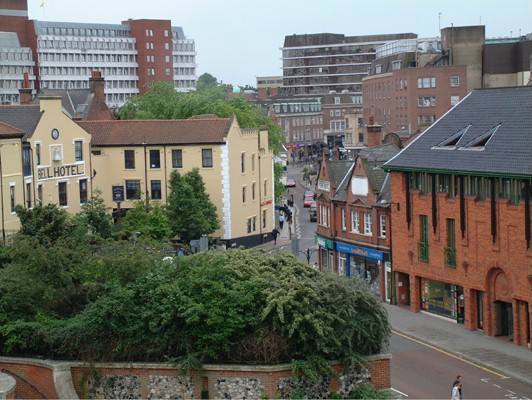
Satan came too, and persecution increased. The society was forced to build a huge wooden tabernacle at Timberhill, near the Cattle-market. The persecutors, calling themselves the Hell-fire club, met at a nearby inn, the Bell Hotel.
The rioters descended on the Tabernacle during a meeting. They wrecked the wooden Tabernacle, injured many of the congregation, and nearly killed Mr. Wheatley, only prevented by the personal intervention of the mayor.
The Hell-fire club stirred up the people with an unreasoning partisan bigotry for the Church of England, and the Baptists and Congregationalists also suffered from their fury. Men were beaten up, women raped, for being Dissenters or Methodists. Public order threatened to break down completely, and yet the cry of this mob was "Church and King! down with the meetings!"
If we really want revival (and we should) we ought to consider these things.
When some semblance of order had been restored Wheatley and his people decided to put up a permanent building. A piece of land was purchased in Bishopsgate, close to the river, and the prominent local architect Thomas Ivory (1709-1779) was engaged to design what was to be the largest chapel in Norwich. Externally quite plain, it had a splendid mahogany pulpit and seating for several thousand. George Whitefield preached at its opening.
Rev. Robert Robinson, author of 'Come Thou Fount of every Blessing' was connected with the Tabernacle before he became first an Independent, then a Baptist.
Sad to say, Wheatley fell into sin again, and resigned his ministry. In 1858, at Wheatley's request, the society entered into connexion with John Wesley. This was a huge mistake. Founded on Calvinistic principles, taught by men like Whitefield, the people could not stand the strident Arminianism of Mr. Wesley's men. On one occasion, when one of Wesley's preachers tried to ram Arminianism down their throats, members of the congregation raised an outcry, running up and down the gallery stairs crying "heresy!"
The people of Norwich have never been afraid to speak their minds!
Shortly before he died, Wheatley withdrew the church he had founded from Wesley's oversight, and in 1775 it came into the hands of the Countess of Huntingdon. She sent students from her college at Trevecca to supply the pulpit.
The first settled pastor there was Mr. Mark Wilks, who was a gifted preacher. In due time he became a Baptist and set up a church nearby, taking several members of the Tabernacle congregation, who had also become Baptists, with him.
It was to this church, meeting in a magnificent building which had echoed to the voices of the great leaders of the revival of the 18th century, that John Alexander was sent on Good Friday, 1817. What awaited him was a church that was suffering trials and difficulties.
Of which more, God willing, next time.

Labels:

Wednesday, November 22, 2006

Dr. John Alexander of Norwich: II.

As the son of a great evangelist, John Alexander had a distinctly unusual childhood. A minister's son, he found it easy to identify with the side of orthodoxy, not because he was converted, but because it was his father's side. On one occasion, while arguing with a friend, William Whewell(who later became Master of Trinity College, Cambridge), John actually knocked him down. Looking back, he wrote, "To my shame I speak it, I have contended for the truth, and I once fought for it, when, at the same time, the truth was not in me."
William Alexander was keen that his son should learn what his father did, and on several occasions, when William was going to preach in a street, he sent John to one end of the street to knock on the doors and invite the people to the preaching, while he started at the other end. John disliked the insults he got from some people, but his father replied that they called Christ Beelzebub."
In 1807 John Alexander left his father's house to be apprenticed to a woollen merchant in Liverpool. Of course the 'Lancashire Apostle' had made sure his son was apprenticed to a Christian, and John Alexander learned more about a Christian household in his master's home. More importantly, he learned how a man can be an earnest Christian and NOT be a minister.
John Alexander was not one of those men with a remarkable conversion experience. Unlike his father he had no day that he could name on which he passed from death to life. Nevertheless, pass he did.
As time went on, John Alexander became aware of a call to the ministry, and in 1814 he left Liverpool for the Hoxton Theological Academy in London. William Alexander warned his son that there was only one reason any man should train for the ministry, and that was a divine call. "God forbid you should take it up except in compliance with the will of God," he wrote. Ministers 'merely on man's making' were a bane to the church.
William Alexander also warned his son about the MATTER of his preaching, "I hope you will never be a half-way preacher. God forbid!" he wrote. "I say, John, preach Christ. Don't say Christ is not in the text; He is in the Bible; that will do. Put man down, put Christ up," the devoted evangelist implored his son. May we not detect in these words the fears of a man who had never been to any theological College, but who had seen and heard young men conceited in their own pride preaching sermons that were mere academic exercises? God forbid that we should denigrate theological colleges, but we should always beware of the snare of spurious 'knowledge falsely so-called' that puffs up.
The old 'Lancashire Apostle' had it right. He sent his son to college, but he warned him that the only sort of theological college that is worth anything is one that exalts Christ.

"Put man down, put Christ up." That was William Alexander's motto. You can hear the revival preacher in those words, "Put Christ up!" Yes, put Christ up! The Lamb is worthy! Put Him up! Put Him up! The highest place belongs to Him!
John Alexander would have cause in the years to come to thank his father for those words. And so have we.

What John Alexander's 'putting Christ up' led to we shall see, God willing, next time.

Labels:

Tuesday, November 21, 2006

Dr. John Alexander of Norwich: I.


Writing of A. B. Taylor of Manchester reminded me of the Scottish diaspora. After the Union of England and Scotland many Scottish craftsmen like Taylor came to England in search of a better life and a better pay-packet. Many settled in Lancashire, where a separate Scottish community grew up. Incidentally this Scottish diaspora paved the way for the later 19th century re-organization of the English Presbyterian Church around churches founded by these Scottish immigrants.
But our subject for this series was the son of one of these Scots living in England in body, but in spirit still very much living in Scotland.
William Alexander was a native of the village of Stoneykirk on the Mull of Galloway (Kirk pictured). He trained as a carpenter in Glasgow, but at the age of twenty, in 1783, he walked frpom there to Lancaster to join a brother who was already working there and who had advised him that there was more regular employment to be had there.
William Alexander had been brought up in the Kirk, and as he first set foot on English soil he stood still, removed his hat and prayed that God would keep him from evil company and give him grace to serve Him. Like A. B. Taylor, William Alexander had been warned about the evil manners of the people of England - apparently it was a common opinion in Scotland that the English were very wicked people!
The conscientious Scot quickly settled down in England, where he married. But his religion was also tried there, and made deeper. In a strange land he felt a deep and overwhelming loneliness, in which it seemed that no man cared for his soul. And in that loneliness a young clergyman was sent to him, a young man who had passed through the same conflict. William Alexander was brought into full assurance, and he could not but tell of the things God had done for his soul. He joined a Congregational church in Lancaster, where he became a leading member, not because he was wealthy in the things of this world, but because he was zealous for God.
In due course he became a preacher, working at his bench for six days of the week, and on the Lord's Day walking a circuit of over thirty miles, no matter how bad the weather was, preaching at three, four, sometimes five, places, eating dinner as he walked and tea 'when he had time'. Only the fact that he had a constitution of phenomenal strength saved him from an early grave.
Many were converted under his ministry, and the Congregational churches of Lancaster recognized an extraordinary call to the ministry. 'The Lancashire Apostle', as he had become known, was never wealthy, never the pastor of a great church as the world counts greatness. But he was the instrument of many conversions. He did not look for any earthly reward, but looked for a better reward, an eternal one.
His son John was born in 1892, and was practically brought up in a chapel. His earliest memories were of the church - one of them contering around an occasion when the little boy was looking around the chapel and his eyes lighted on the gleaming dove that formed the centre of the chandelier. Delighted, the child cried out, "Look, Momma, there's a Dicky Bird with a leaf in his mouth." What happened next can be imagined.

Although he was a hard worker, William Alexander did not neglect his children. A true son of the Kirk, he taught his children the Westminster Shorter Catechism, and he took a keen interest in their reading and education. And he was rewarded for this dilligence as well.
How he was rewarded in his son John shall be our subject in this series, of which more, God willing, next time.

Labels: