Wednesday, November 23, 2005

Who Was That Masked Prophet? X

Selections from the works of Alexander Peden

Because Peden lived and died during times of persecution, and his 'study' was a cave in the ground, he has not left much in the way of writings. We have two sermons, four letters and some 'Notes on the Covenant of Redemption' amounting to a single sheet of paper. These may be found on pages 182-220 of Johnston's book (see last post and here). The two sermons were preached out of doors in Peden's old parish of New Luce. The first sermon was on the text Matthew 21.38.

"Now, people of God in Scotland, what are ye doing when such dreadful wrath against God is at the door in Scotland? He is not worth his room in Scotland the day that prayeth not the half of his time, to see if he can prevent the dreadful wrath that is at your door, coming on your poor motherland. O sirs! ye must pray ploughing, harrowing, and shearing, ay and at all your labour, ay, when ye are eating and drinking, going out and in, and at all your employments; there never was more need than now. O that noble life we might have of communion with God! O sirs! it is He that makes heaven pleasant; it's communion with God that makes heaven pleasant. Will ye long to be there, O people of God?"

"Young folk, what are ye doing? Will ye venture to close with Him, lads and lasses in Scotland, and I will tell you news of it. The lads and lasses that have followed Him in the stormy blast, and laid down their lives for Him, your eyes, sirs, shall see them on thrones, and crowns on their heads, and robes of glory, with harps and palms in their hands, as ye may see in the Revelation 7th chapter and 9th verse."

"Grace is young glory at your conversion. Our Lord gives you one end of His line, but He keeps the other end in glory with himself; and He will have you there, sirs, at length."

And from the second sermon, on Luke 24.21:
"Where is the Kirk of God in Scotland this day? It is not among the great clergy folk. Sirs, I'll tell you where the Kirk of God is - wherever there is a praying lad or lass at a dyke-side in Scotland, a praying party will ruin them [the oppressors of the Church] yet, sirs, and a praying party shall go through the storm."


Words for our day as well as that day. May we learn from the Masked Prophet of the Covenant.

Labels:

Tuesday, November 22, 2005

Who Was That Masked Prophet? IX

Conclusion

As we saw in the last post, Peden was buried at the foot of the gallows on the hill above Cumnock. But the 'place of ignominy' was hallowed by the prophet's bones, and it became the town's burying-place.
Think! no more in the old graveyard
Will anyone bury his dead!
They carry them high to the Gallows Hill,
And lay them there at his head.
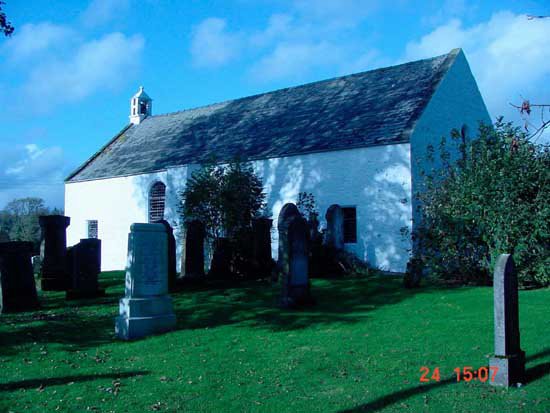
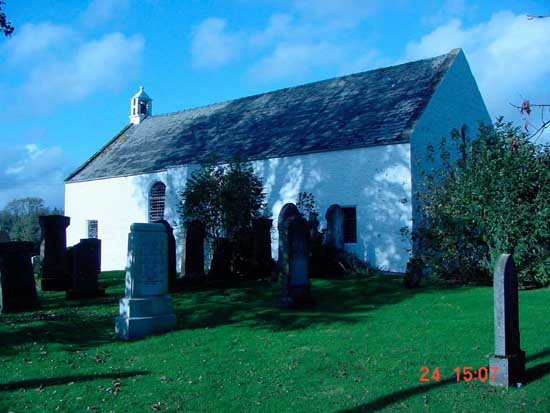
An old hawthorn-tree grows over Peden's grave, and there is a little Reformed Baptist chapel across the road. It is a quiet, affecting spot.

But what are we to make of Peden? He was no deciever, that is certain. What was he? A prophet? Or just a preacher gifted with remarkable insight?
Peden saw himself as a minister called by God to watch over the flock of God in Scotland in peculiarly perilous times. Some of his prophecies, particularly those concerning the battles of Pentland and Bothwell Bridge may be regarded as examples of keen insight. The rebel armies could never have hoped to beat well-trained government troops, and the result of such unsuccessful risings was bound to be further oppression. But can we dismiss all of Peden's prophecies this way? It would be neat and tidy to. I am no charismatic, but I find that I cannot dismiss Peden. God is still able to guide his people today by extraordinary as well as ordinary means. Why should He not have chosen to give some special words of comfort to His persecuted people through Peden? Times of persecution are extraordinary times, after all.

No doubt some of you will accuse me of sitting on the fence. Maybe I am engaging in fence-sitting, but I cannot dismiss The Prophet of the Covenant easily.

(All factual information in these posts has been obtained from the book Alexander Peden: The Prophet of the Covenant, by John C. Johnston, published in 1988 by the Mourne Missionary Trust of Northern Ireland. The book is available from the Free Presbyterian Bookroom, Glasgow. Futher information about Peden may be found here and here, not to mention here. )

We have not quite left Peden. God willing I shall post a number of Peden quotes here from his letters and sermons.

Labels:

Saturday, November 19, 2005

Who Was That Masked Prophet? VIII


The Last Prophecy

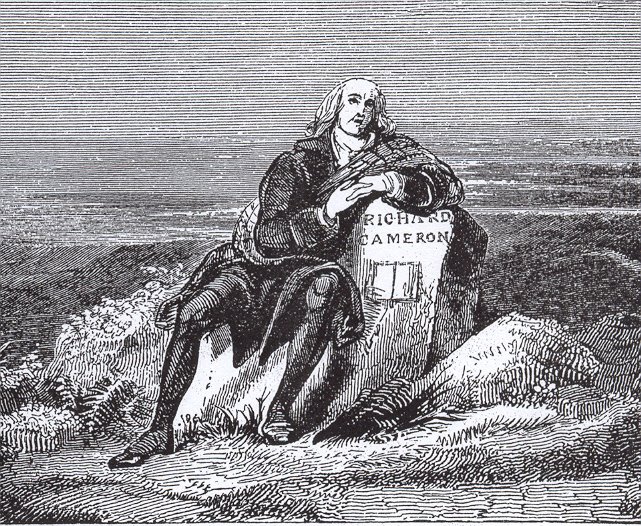
In his latter years Peden became more and more isolated, as his friends were murdered one by one by the government. After the death of Richard Cameron, the best known of the Covenanter leaders, Peden regularly visited the grave of Cameron often, being heard to say, "O to be wi' Ritchie.
There came a worn and weary man to Cameron's place of rest;
He cast him down upon the sod - he smote upon his breast -
He wept as only strong men weep, when they must weep or die,
And 'O to be wi' thee, Ritchie!' was still his bitter cry.

Upon wild and lone Airsmoss down sank the twilight grey,
In storn and cloud the evening closed upon that cheerless day;
But Peden went his way refreshed, for peace and joy were given,
And Cameron's grave had proved to him the very gate of heaven.
(Mrs. Menteath)

Late in 1685, Alexander Peden's health began to fail. "Take my corpse to Airsmoss and lay it beside Ritchie," he said. But he knew that they would be unable to do so. "I shall be decently buried by you, and if my body be suffered to rest in the grave where you shall lay it, then I have been a deciever, and the Lord hath not spoken by me; but if the enemy come a little afterwards to take it up, and carry it away to bury it in an ignominious place, then I hope you will believe that God almighty has spoken by me, and consequently not one word fall to the ground."

Peden died in his brother's house on 26th January 1686. He was buried in the family vault of the Boswells of Auchinleck. Six weeks later, however, government troops came and took the body from the vault. They carried the body to Cumnock, where they were going to hang the body on the gibbet in chains. They were ordered by the local laird, the Earl of Dumfries, that the gibbet was for murderers, not for such men as Peden. The soldiers buried Peden's corpse at that foor of the gallows, 'an ignominious place.' There he still lies, with a monument raised over his now honoured corpse.

The next post will, God willing, be an attempt to examine the story of the Masked Prophet.

Labels:

Who Was That Masked Prophet? VII


The Browns of Priesthill


Despite the rout of the covenanters in arms at Bothwell Bridge, there were still some faithful presbyterians in Scotland. Among them was John Brown of Priesthill (a small farm in the hills of Ayrshire near Muirkirk). Brown was known as 'the Christian Carrier, as he supplemented the small income from his farm by carrying goods for other people.
In 1682 Alexander Peden married John Brown to Isabel Weir. After the marriage Peden said to the bride, "Isabel, you have got a good man to be your husband, but you will not enjoy him long. Prize his company; and keep linen by you to be his winding-sheet, for you will need it when ye are not looking for it, and it will be a bloody one."

In May 1685 Peden returned to Priesthill. He stayed the night with the family, and when the time came for him to depart, Peden was heard to say to himself, "Poor woman, a fearful morning," twice over. And so he went his way.
The following morning John Brown went out to dig peat for fuel. The mist was thick, and it was not until it was too late that Brown realised that Claverhouse, the most ruthless of all the persecutors of the presbyterians, was coming to Priesthill.
Claverhouse's soldiers surrounded Brown and took him to his house, where he was interrogated. John Brown was accused of preaching, but there was no evidence of the charge (in fact Brown had a speech impediment and could not preach). "If he has never preached, meikle (much) has he prayed in his time," Claverhouse answered brutally. "Go to your prayers, for you shall immediately die."
Brown went down to pray, but Claverhouse was so displeased at the length of his prayer that he interrupted. Brown continued to the end of his prayer, and then he was taken out to be killed, his wife and children looking on helplessly. Brown bade fare-well to his family and kissed them, wishing God's blessings on them. Six of Claverhouse's men formed the firing-squad, and most of the bullets struck Brown's head, killing him instantly.
"What thinkest thou of thy husband now, woman?" Claverhouse mocked. "I ever thought much good of him, and now as much as ever," she replied bravely. She was left with her husband's corpse.
Brown was killed between six and seven in the morning, and Peden was ten or eleven miles away, having been travelling through the night. He arrived at a safe house between seven and eight in the morning, in time for family prayer. During those prayers he said, "Lord, when wilt thou avenge Brown's blood?" After prayers his host asked what Peden had meant. "Claverhouse has been at Priesthill this morning and has cruelly murdered John Brown. His corpse is lying at the end of his house, and his poor wife sitting weeping by, and not a soul to speak comfortably with her."
And so it was. There are other reports of Peden's prophetic gift, but I have detained you too long on this matter already, so that the next instalment (God willing) shall be the last prophecy of Peden.

(Illustration: John Brown's grave at Priesthill. Taken from the Alexander Peden page)

Labels:

Friday, November 18, 2005

Who Was That Masked Prophet? VI

The Return of the Exile

(The battle of Bothwell Bridge)


In the summer of 1679, Alexander Peden came North again. At the same time the Covenanters (persecuted presbyterians) had risen again, and were marching on Glasgow. Flushed with success after routing a small force of government troops, they had raised an army to take the second city of Scotland. On 22nd June 1679, the Covenanter army met the government forces in battle at Bothwell Bridge. Peden was in the borders, many miles from the scene of combat. On the saturday before the battle he had cried out at worship in the family with whom he was staying, "I tell you, sirs, our deliverance will never come by the sword. Many thought, when the bishops were first set up, that they would not continue seven years; but I was never of that mind. It is now near three sevens; they will not see the fourth seven, but I fear they will come near to it." The Episcopalian regime was not overturned until 1688.

The two armies met on the Sabbath, when Peden was due to preach. He said, "let the people go to prayer, for I can preach none. Our friends are fled and fallen before the enemy... and their blood is flowing like water." Throughout the day he spoke of what was happening at Bothwell Bridge, and how it would be such a heavy stroke on Scotland. Only when the battle was done did news reach the Borders.

Depressed by what had happened, Peden went to Ireland for a short time, where he ministered among the Scottish refugees. He soon returned to Scotland and continued to preach, giving occasional 'prophetical words,' if the histories are to be trusted.

The days of the Masked Prophet were growing short, and he would not live to see the end of persecution. There were still two more scenes of prophecy in his life, and to those I intend to turn, God willing, to-morrow.

Labels:

Thursday, November 17, 2005

Who was that Masked Prophet? V

Liberty to Prophesy

On 9th October 1677, the council decided to liberate Peden from the Bass, on the condition that he left Great Britain for ever. He refused, and it was decided to banish Peden from Scotland. He was transferred to the old Tolbooth for another year until, in December 1678, the council condemned Peden to be transported to the plantations in America with sixty-seven other men. In America the men were to be sold as slaves (Think Captain Blood here). The prisoners were put aboard the St. Michael of Scarborough at Leith, the port of Edinburgh.

After the sentence was passed Peden was heard to say, everal times, that the ship had not yet been built that would take him, or his fellow prisoners, to America. To one James Law, one of the prisoners, Peden said, "James, when your wife comes in, let me speak a word with her." He spoke with her. Afterwards, as they prayed, he said, "Good Lord, let no James Law's wife miss her husband, until thou return him to her in peace and safety, which we are sure will be sooner than either he or she is looking for."

But the ship sailed from Leith. There were rumours that torture would be used on the prisoners, but Peden calmed them saying, "Lift up your hearts, for the day of your redemption draweth near. If we were once at London, we will be set at liberty." Another time he was heard saying in prayer, "Lord, we bless Thy Name, that will cut short our voyage, and frustrate Thy wicked enemies of their wicked designs, and will not let them get us where they intend; and some of us shall go richer home, than when we came from home."

And so it was, for when the captain who was to have taken them to Virginia recieved them and found that they were political prisoners and good Christians, he refused to take them in his ship. So all of the prisoners were set free in London. They returned to Scotland, free men once more. Peden remained six months in Scotland, and he returned to find that the Presbyterian cause had suffered a terrible blow.
But that must wait for our sixth installment.

Labels:

Who was that Masked Prophet? IV

The Prophet in Prison

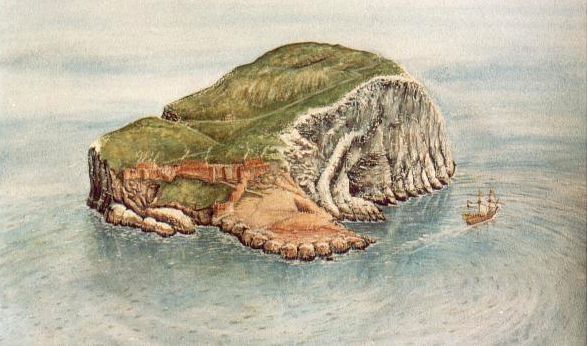
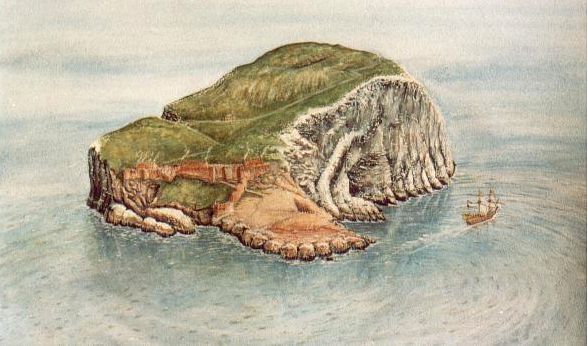
For ten years Peden evaded capture by government forces, roaming the hills dressed in grey, his sword by his side and his identity concealed by his famous mask. In June of 1673, however, while he was preaching at a house-meeting in Carrick, the house was raided and Peden was arrested. He was taken to Edinburgh for trial and, on 26th of June, he was condemned to "close imprisonment" on the Bass rock, an island-prison for political prisoners in the Firth of Forth from which there was no escape.

Because the Bass was escape-proof, prisoners were officially allowed a certain amount of freedom. This was not always respected in practice, and prisoners were kept shut up in cells cut into the rock for days at a time. Soldiers on the Bass tried to seduce the maid-servants who attended on the imprisoned ministers and blame the ministers for the resulting children. The result of this was that few women wanted to work on the Bass. (For the preceding paragraph my authority is the Memoirs of James Fraser of Brea, one of Alexander Whyte's favourite books)

Peden was kept a prisoner on the Bass for four and a half years. One day he saw the fourteen-year-old daughter of the governor of the Bass mocking and laughing as the prisoners conducted their public worship. With a solemn face he turned to the girl and said, "Poor thing, thou mockest and laughest at the worship of God; but ere long God shall write such a sudden, surprising judgement on thee, that shall stay thy laughing, and thou shalt not escape it." Shortly afterwards, while the girl was walking on the rock, a gust of wind blew her into the sea, where she was lost.

But Peden's prophetic reputation was also used to good. On another occasion Peden was walking on the rock, and a number of soldiers walked by. One said of Peden, "the devil take him."
"fy, fy, poor man, thou knowest not what thou art saying," Peden said to the man, "But thou wilt repent that."
The soldier was terrified, taking Peden's words as a prophect that the devil would take him. Convicted of his guilt in persecution, the soldier was converted and left the King's service, returning to his home, where he became a noted Christian.

There were some prisoners who died in the Bass, others remained in prison unil the end of the persecution. Peden regained his freedom - but that will be the subject of our next post (D.V.)

Labels:

Who Was That Masked Prophet? III


The Prophet of the Covenant


The ejected ministers were to remain silent or to face the consequences, outlawry, persecution, prison, exile and even death. Some of the older ministers went to Holland and a Scots expat. community grew up around them. But many stayed in Scotland; their voices would not be silent and, forced out of the churches, they took to the open air:
"The minister's home was the mountain and wood."
They took particularly to the wild country of the South-west of Scotland, "a land of intricate rolling hills, clear streams, remains of ancient forests with, on the one hand, green smiling valleys that stretch to the sea, and at their heads, on the mountain summits, breadths of waste moorland and labyrinths of bogs and morass, the haunts of the curlew and lapwing, that break the deep solitude with their wild, melancholy cry." (John C. Johnston, Alexander Peden)
Peden was denounced as a rebel on 25th January, 1666. To recieve him was a crime against the state, and to hand him over to the authorities an act of loyalty. His crime? Preaching the Gospel. His hearers were threatened with death. At last, in November 1666, the oppressed people rose. They captured the King's commander and marched on Edinburgh. Peden went with them for a while, but at length he turned back, "Being persuaded that they would fall and flee before the enemy."
That was not necessarily prophetic. The rebels continued to the Pentland Hills, just outside Edinburgh.
A couple of nights later, Peden was dining with friends in Carrick, sixty miles from Edinburgh. He was seen to be very troubled and distressed by something. When his landlord asked him what the trouble was, Peden replied, "To-morrow I will speak with you," and retired to pray, not sleeping all night.
Early in the morning Peden called to his landlord and said, "I have sad news to tell you; our friends that were together in arms for Christ's interest, are now broken, killed, taken and fled every man." The news came by foot some forty-eight hours later.
Despite not being present at Pentland, Peden was condemned for being there. But Peden did not leave Scotland, he went on preaching up and down the country, even visiting Ireland in 1670, to encourage the Scots presbyterian exiles there.
But Peden, despite some hair's breadth escapes, did not remain at liberty for ever. But more of that in our next instalment.
(Illustration: Peden's Pulpit, Gameshope, Tweedsmuir, http://www.ancient-stones.co.uk/borders/041/047/details.htm)

Labels:

Wednesday, November 16, 2005

Who was that Masked Prophet? II

The First Prophecy
While we do not have accounts of every farewell sermon preached by the four hundred ejected ministers, we do have an account on Peden's, although it is undated. The text was Acts 20.32: "And now, brethren, I commend you to God and to the word of his grace, which is able to build you up, and to give you an inheritance among all them that are sanctified." Most of the congregation were in tears. Peden called upon them to be quiet, but when he told them that they would never see his face in the pulpit again, they wept all the more. He carried on preaching well into the night and, when the sermon was over, he came out of the pulpit and closed the pulpit door. Having done that, he knocked three times on the pulpit door with his Bible and uttered the first of his prophecies.
"I arrest thee in my Master's Name, that none enter thee but such as come in at the door, as I did."
By which he meant that, "Peden fenced the pulpit of Glenluce, and declared that none of the curates should ever set foot in it." (Robert Gordon) And, strange to say, no minister ever did until 1693, when William Kyle was inducted according to the Presbyterian form. And so was born the story of Peden the Prophet.

And the mask? As shown at the head of the last post, it was a disguise later adopted by Peden when he was a hunted man. More of which anon.

Labels:

Who was that Masked Prophet? I.


I threatened this post on the Pyromaniac comments page the other day. With all this talk of prophets and prophecies today, the Highland Host decided to bring the searchlight of Scottish Church history to bear upon this matter.
Doubtless some have heard of Alexander Peden, and those who know his background can skip this introductory post and come back later for the meat and potatoes, so to speak.

Alexander Peden was born in the parish of Sorn, Ayrshire, in 1626. Of his childhood we know only that he had one. In due course he went up to the University of Glasgow, but all we know of his time there was that he was a good student. When his university course was complete, Peden took the post of schoolmaster, precentor and session-clerk at Tarbolton, a parish neighboring Sorn. At some point either before or after this, Peden was precentor for William Guthrie at Fenwick.
Peden was ordained to the recently established parish of New Luce in 1659, the second minister to serve the parish since its creation in 1647. Peden served in New Luce for only three brief years. Refusing to swear the oath of allegiance to King Charles II as "only supreme governor of the kingdom over all persons and in all causes civil and ecclesiastical", Peden was ejected from the parish in 1662, one of four hundred ministers ejected in all of Scotland. He was prohibited from preaching, and spent the rest of his life as a fugitive, preaching where he could, hiding in caves and dens of the earth. And around his head gathered the reputation of a prophet.
To which I shall turn, the Lord willing, in the next post.

Labels: