Wednesday, August 23, 2006

Christmas Evans & Sandemanianism 9: Concluding thoughts.

His meeting with God on the mountain had restored Christmas Evans' zeal for evangelism, and God would once more use him to win many to Christ.

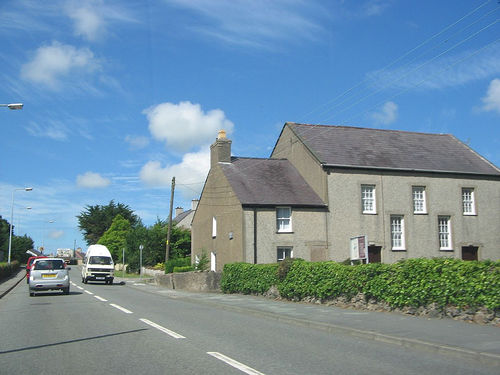
As for J. R. Jones, Ramoth, he seceded from the Welsh Baptists after 1798 after a meeting in which he accused the Welsh Baptists of: ‘errors in faith and practice’. He joined the Sandemanian ‘Scotch Baptists,’ along with the Churches that followed him.[1] On his death in 1822, however, he was on the verge of leaving the Scotch Baptists because of a disagreement about eschatology.[2] Many of his churches at that point re-joined the Welsh Baptists, although some, like the little chapel at Criccieth, redoubled their efforts. Rejecting the idea of a paid ministry, this chapel called as one of its two elders David Lloyd, a shoemaker. His grandson, Prime Minister David Lloyd George, was named after him. By the time he came to Criccieth, however, the church had split with the Scotch Baptists and embraced Campbellite principles.

What, then, can this singularly unhappy episode teach us? The first is that the Church is most in danger from error and heresy at the close of times of blessing. Sandemanianism emerged into England and Wales in the wake of the Great Awakening, as the initial fervour was cooling. Similarly Sandemanianism among the Baptists of North Wales occurred in a pause between two movements of the Spirit. At these times we must be especially careful. Secondly, we learn that the effect of Sandemanianism is coldness and a dropping away of hearers, for Sandemanians are keener to make converts to their system than converts to Christ. Accordingly, Sandemanians, like the promoters of similar errors today, will tend to pitch their address to Christians, not enquirers, and often concentrate on new believers. As systems, these tend to attract controversialists and breed divisiveness and pride.

Finally, however, and here I must rebuke myself, we learn that our methods should be those of Thomas Jones of Glyn Ceiriog, firm but polite. Remember, brethren: ‘Yet Michael the archangel, when contending with the Devil he disputed about the body of Moses, he dared not bring against him a railing accusation, but said, the Lord Rebuke you.’ In dealing with those who we believe are guilty of a serious distortion of the Word of the Lord, of ‘turning the grace of God into licentiousness,’ we must remember that our behaviour will witness to the truth of our faith. Men were drawn to Glas by his holy life. They should be drawn to the wells of life and truth by a holy winsomeness. Let railing and blasphemy be the province of heretics, not the field on which Christians enter. And above all, let there be no bitterness, only a holy zeal to bring back the Master’s straying sheep.

[1] J. Hugh Edwards, MP, The Life of David Lloyd George with a Short History of the Welsh People (London, 1913), vol.ii, pp.59-60.
[2] Tim Shenton, Christmas Evans: The Life and Times of the one-eyed Preacher of Wales (Darlington, 2001), pp.59-60.

Labels:

Tuesday, August 22, 2006

Christmas Evans & Sandemanianism 8: The Melting Heart

His experience with Sandemanianism had left Christmas Evans' heart cold. But God had not finished with him. A journey from Merioneth to Montgomeryshire saw Christmas Evans visited by the Holy Spirit. Reproduced below is his own account of the experience (spelling has not been changed):

'On a day ever to be remembered by me, as I was going from Dollgelly to Machynlleth, and climbing up towards Cadair Idris [pictured], I considered it to be incumbent upon me to pray, however hard I felt my heart, and however worldly the frame of my spirit was. Having begun in the name of Jesus, I soon felt as it were the fetters loosening, and the old hardness of heart softening, and, as I thought, mountains of frost and snow dissolving and melting within me. This engendered confidence in my soul in the promise of the Holy Ghost. I felt my whole mind relieved from some great bondage: tears flowed copiously, and I was constrained to cry out for the gracious visits of God, by restoring to my soul the joy of his salvation; - and that he would visit the churches in Anglesea, that were under my care. I embraced in my supplications all the churches of the saints, and nearly all the ministers in the principality by their names. This struggle lasted for three hours: it rose again and again, like one wave after another, or a high flowing tide, driven by a strong wind, until my nature became faint by weeping and crying. Thus I resigned myself to Christ, body and soul, gifts and labours – all my life – every day and every hour that remained for me; - and all my cares I committed to Christ. – The road was mountainous and lonely, and I was wholly alone, and suffered no interruption in my wrestlings with God.

‘From this time, I was made to expect the goodness of God to churches and to myself. Thus the Lord delivered me and the people of Anglesea from being carried away by the flood of Sandemanianism. In the first religious meetings after this, I felt as if I had been removed from the cold and sterile regions of spiritual frost, into the verdant fields of the divine promises. The former striving with God in prayer, and the longing anxiety for the conversion of sinners, which I had experienced at Leyn, was now restored. I had a hold of the promises of God. The result was, when I returned home, the first thing that arrested my attention was, that the Spirit was working also in the brethren in Anglesea, inducing them in a spirit of prayer, especially in two of the deacons, who were particularly importunate that God would visit us in mercy, and render the word of his grace effectual amongst us for the conversion of sinners.’[1]

[1] Reproduced in Joseph Cross, ‘Memoirs’, in Sermons and Memoirs of Christmas Evans (New York, 1856, reprinted Grand Rapids, 1986), pp.256-7.

Labels:

Monday, August 21, 2006

Christmas Evans & Sandemanianism 7: The Bold Champion

As we have seen, under the influence of the Sandemanian teachings brought in by John Jones, Ramoth, and embraced by Christmas Evans, the Baptist cause in North Wales had begun to decline. There was every chance that the Baptist cause might be extinguished altogether, as had the Methodist Societies in the North of England, by a combination of coldness and division. But it was not God's will that the Baptist cause should perish.

As the Sandemanian error crept over the Baptist churches of the North, God raised up as a deliverer Thomas Jones of Glyn Ceiriog, Denbighshire (pictured). Thomas Jones was steeped in the Bible to such an extent that Christmas Evans declared ‘Wherever Thomas Jones was, no concordance would be necessary!’ His Church split in 1796 over Sandemanianism, his co-pastor, John Edwards, having embraced the doctrine. Seeing the pernicious effects of the doctrine first-hand moved Thomas Jones to combat it. Unlike his opponents, who bitterly reviled him, Thomas Jones stood firmly but graciously upheld the true Gospel. At the 1802 Llangefni Association meeting, he preached powerfully against Sandemanianism, effective breaking its power over the majority of Welsh Baptists, including Christmas Evans.[1]

But Christmas Evans' heart was still not restored. For that, he had to wait the visitation of God. Tomorrow we shall reproduce his own account of that gracious, famous hour.

[1] Tim Shenton, Christmas Evans: The Life and Times of the one-eyed Preacher of Wales (Darlington, 2001), p.175; B. A. Ramsbottom, Christmas Evans (Harpenden, 1985), p.52.

Labels:

Saturday, August 19, 2006

Christmas Evans & Sandemanianism 6: The Bogs of Sandemanianism

The effect on Christmas Evans himself was just as bad, as he later confessed, after he had been saved from the bogs of Sandemanianism.

‘The Sandemanian heresy affected me so much as to drive away the spirit of prayer for the salvation of sinners. The lighter matters of the kingdom of God pressed heavier on my mind than the weightier. The power which gave me zeal and confidence and earnestness in the pulpit for the conversion of souls to Christ was lost. My heart sank within me, and I lost the witness of a good conscience. On Sunday night, when I had been fiercely and violently condemning errors, my conscience felt ill at ease, and rebuked me because I had lost communion and fellowship with God, and made me feel that something invaluable was now lost and wanting. I would reply that I acted according to the Word. Still it rebuked me, saying that there was something of inestimable value gone. To a very great degree I had lost the spirit of prayer and the spirit of preaching.’[1]

Jones, Ramoth, an able controversialist, fell out with all around him, deliberately alienating the majority in the belief that all majorities were wrong.[2] Evans followed him in controversy, treating all who disagreed with the Sandemanian view as apostate or at least guilty of serious heresy. He was quite unmerciful. A coldness crept over the heart of the one-eyed Baptist. And he mourned for the loss of his first love, little understanding why his ardour had cooled so. New believers found themselves confronted with ‘doubtful disputations,’ not instruction in following Christ. No doubt some theological controversy necessary, but is the precise manner of breaking the bread at the Lord’s Supper really a right reason for splitting a church?[3]

Under the influence of Sandemanianism, the Baptist churches of Wales had begun to major in minors, while treating the most vital thing of all, saving faith, as but a small thing.


[1] Quoted in Owen Jones, ‘Christmas Evans’, in some of the Great Preachers of Wales (London, 1885, republished Hanley, 1995), pp.159-60.
[2] Tim Shenton, Christmas Evans: The Life and Times of the one-eyed Preacher of Wales (Darlington, 2001), pp.157-160.
[3] Tim Shenton, Christmas Evans: The Life and Times of the one-eyed Preacher of Wales (Darlington, 2001), pp.171-4.

Labels:

Friday, August 18, 2006

Christmas Evans & Sandemanianism 5: The Church and Sandemanianism

The character of Christmas Evans' preaching changed markedly. Appeals to the awakened consciences of hearers were dropped in the belief that this promoted works. John Jones, Ramoth held that:‘[…] Christianity was a minority religion and in order to retain its purity it had to abstain from appealing to the indifferent multitude.’[1] All manifestation of emotion was suppressed and sermons became dry discourses, reasoning gravely replaced revivalism.

“Very well,” it may be objected, “but reasoning is good, is it not? Indeed, do not your Reformed services involve reason?” Well, we shall agree with this. However, the Sandemanian preaching had a deadening effect, as zeal to make converts for Christ was replaced with zeal to make converts to Sandeman. As to its effects on the churches in general, I leave that to Christmas Evans:

‘Its first effect was to send away the hearers of the gospel; for this it prepared the way by alleging that the mass of hearers were ‘of Babylon.’ I lost in Anglesey almost all my old hearers; many of them attended the ministry with other denominations, and became united with them. There they had rest from the new condemning spirit among us. […]

Much distraction in the churches followed; a spirit of infallibility and worldly wisdom fell upon the people and on many of the preachers, until the weakest felt himself qualified to govern the church and the world.’[2]


[1] Tim Shenton, Christmas Evans: The Life and Times of the one-eyed Preacher of Wales (Darlington, 2001), pp.160-1.
[2] Quoted in B. A. Ramsbottom, Christmas Evans (Harpenden, 1985), p.51.

Labels:

Thursday, August 17, 2006

Christmas Evans & Sandemanianism 4: J. R. Jones & Christmas Evans

J. R. Jones, Ramoth lived in the county of Merioneth in North-West Wales. At the age of eighteen, he began to preach among the Independents (Congregationalists). However a Baptist mission to his home village of Llanuwchllyn led to his conversion to Baptist principles. He was ordained in 1788 to the ministry at Ramoth and was given oversight of the Baptist Churches throughout Merionethshire. Three years later, Christmas Evans took charge of the Chapel at Llangefni, with oversight of the Baptists of Anglesey.[1]

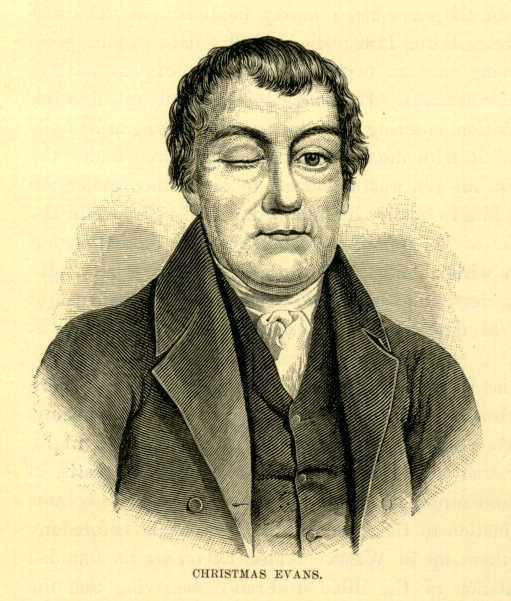
Born at Llandysul, Ceredigion on Christmas Day, 1766, Evans had experienced grinding poverty as a child. His father had died while Christmas Evans was an infant and he had been brought up by a drunkard uncle who had shamefully neglected him. The kindness of the Arian Minister of Llwynrhydowen, David Davies, had led to the young man receiving an education. Strangely enough, under the ministry of this markedly unorthodox man, young Christmas fell under deep conviction of sin. He listened intently to each sermon and then preached them back to the farm animals under his care! [2] In the course of his struggles with indwelling sin, Evans had to fight with men as well as the devil. While considering the call to preach, he was set on by a gang of ruffians who beat him to within an inch of his life, destroying his right eye. This, together with a vision of Christ’s Second Advent, Evans interpreted as a sign that he should continue to study for the ministry. After a period of supplying pulpits for the Methodists and Independents, he embraced Baptist principles and was baptised in the river Duar in 1788.[3] The denomination then stood on the cusp of a period of awakening. In 1789, the Baptists of North Wales invited Christmas Evans to conduct a mission among them. After a period of wrestling with God in prayer, Evans agreed. After two years in Lleyn, Caernarfonshire, he moved to Anglesey and took the pastorate of Llangefni, left vacant after the previous pastor had resigned in disgrace.[4]

In 1796, J. R. Jones, Ramoth, began to preach the principles of Sandemanianism among the Baptist Churches of North Wales:[5] Reading a number of the works of Alexander McLean, a leading Scottish Sandemanian, advocating ‘[…] a rigid observance of the Apostolical tenets and customs […]’, Jones became convinced in 1894 that this was true Christianity. Accordingly, he introduced such practices as the ‘Holy Kiss’ and foot washing to his church. The latter seems to have been met with serious opposition – and no wonder in an age where many of the common people went unshod![6] These practices were made mandatory in the churches that followed Jones, Ramoth. Hard on the heels of the practices of the Sandemanians came the doctrine. While bare belief of the truths contained in the Bible was seen as enough for saving faith, strict adherence to the peculiar practices was considered as necessary for soundness in the faith.[7] Sadly Christmas Evans, a man ‘[…] liable to be swayed to a great extent by the opinions of others’, was borne along in the Sandemanian tide.[8] He professed, in a letter of about 1796, addressed to a church in Swansea, as to faith: ‘This, wrought by the Lord, is no more than a belief in the word of the Lord as true; to believe the account of the life, death, resurrection, and ascension of Christ […].’[9]

[1] J. Hugh Edwards, MP, The Life of David Lloyd George with a Short History of the Welsh People (London, 1913), vol.ii, p.58.
[2] B. A. Ramsbottom, Christmas Evans (Harpenden, 1985), pp.9-12. Indeed, the young farm-boy had created a ‘chapel’ for his ‘congregation,’ complete with pulpit!
[3] Tim Shenton, Christmas Evans: The Life and Times of the one-eyed Preacher of Wales (Darlington, 2001), pp.61-2.
[4] Owen Jones, ‘Christmas Evans’, in some of the Great Preachers of Wales (London, 1885, republished Hanley, 1995), pp.154-8.
[5] Thomas Rees, History of Protestant Nonconformity in Wales, from its Rise to the Present Time (London, 1861), p.412.
[6] J. Hugh Edwards, MP, The Life of David Lloyd George with a Short History of the Welsh People (London, 1913), vol.ii, pp.58-9.
[7] B. A. Ramsbottom, Christmas Evans (Harpenden, 1985), pp.50-1.
[8] Owen Jones, ‘Christmas Evans’, in some of the Great Preachers of Wales (London, 1885, republished Hanley, 1995), p.159.
[9] Quoted in Tim Shenton, Christmas Evans: The Life and Times of the one-eyed Preacher of Wales (Darlington, 2001), p.171.

Labels:

Wednesday, August 16, 2006

Christmas Evans & Sandemanianism 3: The Calvinistic Methodists

Sandemanian doctrine initially found its way into Wales at the end of the Great Awakening in the Calvinistic Methodist Societies (which were still part of the Established Church), as a reaction against the emotional and physical manifestations which accompanied the preaching of such men as Daniel Rowland, Wesley and Whitefield. Some felt that their preaching set up an emotional response as a work, and they were recovering salvation by faith alone.[1] John Popkin of Swansea, an ‘Exhorter’ (lay-preacher) was the first Welsh proponent. At the Woodstock (Pembrokeshire) Association of the Calvinistic Methodists, he clashed with elder statesmen Williams Pantycelyn and Daniel Rowland over the questions of the Establishment, the creeds and saving faith, proclaiming himself ‘a plain believer.’[2]

A man of means, Popkin published works promoting Sandemanianism and translated the works of Glas and Sandeman into Welsh.[3] According to Eifion Evans, ‘his preaching tours […] sowed dissention and confusion […].’ David Jones, from Rowland’s native Llangeitho, a notable preacher, was influenced.[4] However, the influence of Sandemanianism in Welsh Calvinistic Methodism was peripheral. I shall let Thomas Rees conclude their history:

‘They succeeded in a short time in perverting many of the members of societies, and some of the preachers; but the bold and determined stand made by Williams of Pantycelyn, and other leading men, against them, soon arrested the progress of the evil. Popkins [Sic.] withdrew from the connexion,[5] and Jones in a short time turned out a reprobate character.’[6]

In fighting off Sandemanianism, Pantycelyn did Wales a service. In the North of England, the coming in of Sandemanianism would effectively destroy many of the Methodist Societies. It would be thirty years before Sandemanianism again reared its head in Wales, and it would be in the Particular Baptists, not the Methodists. In the words of Christmas Evans: ‘A black cloud arose from the churches of the North, and a destructive storm burst from it.’[7] As one who was caught in the middle of it, the celebrated one-eyed preacher was well-equipped to judge.

[1] D. Martyn Lloyd-Jones, ‘Sandemanianism’, in The Puritans: Their origins and Successors (Edinburgh, 1987), p9.175-6.
[2] Derec Llwyd Morgan, The Great Awakening in Wales (London, 1988), p.191.
[3] Tim Shenton, Christmas Evans: The Life and Times of the one-eyed Preacher of Wales (Darlington, 2001), p.153.
[4] Eifion Evans, Daniel Rowland and the Great Evangelical Awakening in Wales (Edinburgh, 1985),p.340.
[5] As was only right and proper. He left no lasting religious legacy.
[6] Thomas Rees, History of Protestant Nonconformity in Wales, from its Rise to the Present Time (London, 1861), p.408.
[7] Cited in Tim Shenton, Christmas Evans: The Life and Times of the one-eyed Preacher of Wales (Darlington, 2001), p.150.

Labels:

Tuesday, August 15, 2006

Christmas Evans & Sandemanianism 2: Faith & Life

But it was not such practices, however eccentric they must have seemed to the majority of Nonconformists that caused Sandemanianism to become a ‘rock of offence and a stone of stumbling.’ No, it was the Sandemanian view of the nature of saving faith. In the words of William Williams, Pantycelyn: ‘[…] it sets naked faith as the chief thing, believing without power, making little of convictions and a broken heart.’[1] Returning to Fuller, who together with Lloyd-Jones, I needs must make heavy use of in this doctrinal section:

‘The foundation of whatever is distinguishing in the system seems to relate to the nature of justifying faith. This Mr. S[andeman] constantly represents as the bare belief of the bare truth; by which definition he intends, as it would seem, to exclude from it every thing pertaining to the will and the affections, except as effects produced by it.’[2]

Saving faith, Sandeman insisted, meant that: ‘Every one who obtains a just notion of the work of Christ, or whose notion corresponds to what is testified of him, is justified and finds peace with God simply by that notion.’[3] And, when a certain Pike, who professed to follow Sandeman, defended Sandeman by saying that he had been misunderstood and in fact meant a ‘hearty persuasion’, not bare assent, was slapped down.[4] All emotional persuasions prior to the acceptance of the facts about Christ were rejected, even shunned.[5]


[1] Cited in D. Martyn Lloyd-Jones, ‘Sandemanianism’, in The Puritans: Their origins and Successors (Edinburgh, 1987), p.175.
[2] Andrew Fuller, ‘Strictures on Sandemanianism,’ Works (Harrisonburg, Virginia, 1988), vol.ii, p.566.
[3] Cited in Andrew Fuller, ‘Strictures on Sandemanianism,’ Works (Harrisonburg, Virginia, 1988), vol.ii, pp.566-7.
[4] Cited in Andrew Fuller, ‘Strictures on Sandemanianism,’ Works (Harrisonburg, Virginia, 1988), vol.ii, p.566.
[5] Eifion Evans, Daniel Rowland and the Great Evangelical Awakening in Wales (Edinburgh, 1985), p.339; Tim Shenton, Christmas Evans: The Life and Times of the one-eyed Preacher of Wales (Darlington, 2001), p.155.

Labels:

Monday, August 14, 2006

Christmas Evans & Sandemanianism 1: Another Gospel

This is a series I have considered for a long time. It is also a series which I take no pleasure in writing, which is perhaps why it has been so long in gestation. I take no pleasure in engaging in controversy, especially not with fellow-Christians, and I understand that, in undertaking to write this series, I shall be seen to be doing just that. However, I feel it to be 'a word in season.' I have recently become aware of the existence of a movement which under the title ‘Free Grace Theology,’ holds that saving faith consists solely in mental assent to the truths of the Gospel (for more see Jenson's Blog). This has been seen before, and its effects on the Church of Jesus Christ were in no way beneficial.

It bears the name, not of its founder, but of its most energetic proponent, one Robert Sandeman. Originating in Scotland, these ideas came to Wales from 1765 onwards, into the societies created by the Great Awakening and into Dissent some three decades later. Now:
Sandemanianism had arisen in Scotland in the 1720s chiefly in reaction against what was felt to be an unhealthy reliance on the authority of man-made creeds. Its founder, John Glas, a Church of Scotland minister in the county of Angus, disagreed with the custom of requiring all ministers to sign the Solemn League and Covenant (a document pledging the Church to maintain Presbyterianism). He believed that requiring a person to submit to a man-made document was wrong and so also refused to subscribe to the Westminster Confession.[1] Finally and most significantly, he held some unorthodox views on the nature of saving faith. This was enough to get him deposed from his charge in 1733. He formed an Independent Church.[2] Glas himself was a man of loving and warm temper, and no doubt his evident holiness did much to persuade others of his system.[3]

In the course of the years, this Independent church and the churches that followed it adopted a number of characteristic practises. In an attempt to return to primitive Christianity the Churches adopted the practice of ‘breaking bread’ every Lord’s Day, as the Plymouth Brethren do. All man-made creeds were rejected, as was the idea of a paid, full-time ministry. Ministers were expected to work during the week to support themselves, although full-time evangelists were maintained by a general fund.[4] Other customs were re-introduced, including foot-washing and the ‘Holy Kiss.’[5]


[1] Given that Glas refused to subscribe to the articles and practice of his church, had he been in a Free Church, rather than an established Church, he should have withdrawn citing conscience rather than continuing to draw a stipend. Only the fact that Glas was a minister of the establishment exonerates him from the charge of bad faith.
[2] D. Martyn Lloyd-Jones, ‘Sandemanianism’, in The Puritans: Their origins and Successors (Edinburgh, 1987), pp.171-2.
[3] Tim Shenton, Christmas Evans: The Life and Times of the one-eyed Preacher of Wales (Darlington, 2001), p.155. It is often the case that heretics exhibit a high degree of holiness in their personal lives. Witness Arius of Alexandria, whose personal sanctity was the best advertisement of his damnable error.
[4] J. Hugh Edwards, MP, The Life of David Lloyd George with a Short History of the Welsh People (London, 1913), vol.ii, pp.65-7.
[5] D. Martyn Lloyd-Jones, ‘Sandemanianism’, in The Puritans: Their origins and Successors (Edinburgh, 1987), p.172.

Labels: